Why do some bird species lay only one egg?
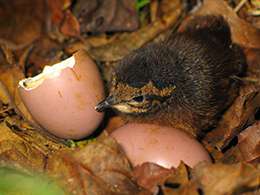
(PhysOrg.com) -- Why do some species of birds lay only one egg in their nest, while others lay 10 or more? A global study of the wide variation among birds in this trait, known as the "clutch size," now provides biologists with some answers. The study, published in the current issue of the journal PLoS Biology, combined data on the clutch sizes of 5,290 species of birds with information on the biology and environment of each of these species.
"With this approach, we were able to explain a major proportion of the global variation in clutch size and also to predict with high confidence the average clutch size for types of birds living and breeding in certain environments," said Walter Jetz, an associate professor of biology at UC San Diego and the senior author of the study. "For example, cavity nesters, such as woodpeckers, have larger clutches than open-nesting species. And species in seasonal environments, especially those living at northern latitudes, have larger clutches than tropical birds."
Clutch size in birds and reptiles has long been studied by biologists, who have found generally that species that are short-lived or have a low survival rate among their offspring tend to lay more eggs at one time to increase the chances of having surviving offspring. In contrast, longer-lived species or those with a higher survival rate among offspring tend to lay fewer eggs in their nests and invest more time and effort in raising their offspring. However, the reasons why one species of bird may lay one egg and another 10 are more complex because clutch sizes can vary widely between closely related species due to variations in their environment, nutrition, health and predation.
The authors of the study—who included Cagan Sekercioglu, a senior research scientist at Stanford University and Katrin Böhning-Gaese of Johannes Gutenberg University in Mainz, Germany-- were aided in their investigation by detailed records of the life histories of birds throughout the world.
"Humanity's fascination with birds since the dawn of time has meant that thousands of ornithologists and millions of bird enthusiasts have been collecting detailed data about birds' lives for centuries," said Sekercioglu. "Published in countless books, popular and scientific articles, these data have made birds the best known major group of organisms."
"In this study," he added, "we answer one of the most basic questions asked about birds: Why do bird species lay different numbers of eggs? The integration of geographic and life history datasets enabled us to simultaneously address the importance of ecological, evolutionary, behavioral and environmental variables in shaping the clutch size of world's birds. We show that increased environmental variation causes birds to lay larger clutches. Most ornithological research has taken place in the highly seasonal environments of North America and Europe, but most bird species live in less seasonal tropics. Therefore, the small clutch size seen in less-studied tropical birds is the norm, not the exception. Increased predation pressure experienced by open-nesting birds also causes them to lay smaller clutches than cavity-nesting birds, literally having fewer eggs in one basket to spread the risk."
The three biologists said they believe this information will become increasingly more important in efforts to protect these birds as rapid environmental changes due to global warming affect these species.
"Our results demonstrate not only where bird species live, but how the way they live their lives, specifically their reproduction strategies, has evolved in close association with climate, particularly seasonality," said Jetz of UC San Diego. "Rapid changes to the global geography of climate are likely to impact both aspects and to potentially perturb the long-evolved link between the 'where' of life and the 'way' of life in many species."
Sekercioglu added: "The majority of bird species live in the tropics. Tropical birds' smaller clutch size is greatly shaped by more stable climates and these birds' survival depends on the continuity of the weather conditions they have adapted to during millennia. Climate change and a potential increase in climatic fluctuations in the tropics may make these birds highly vulnerable. Hundreds of tropical bird species are already threatened with extinction and a potential clash between changing climate and their reproductive strategies may cause additional harm."
Source: University of California - San Diego


