Bee smart, bee healthy
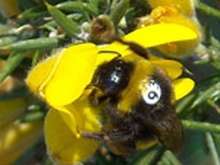
(PhysOrg.com) -- Bumblebee colonies which are fast learners are also better able to fight off infection, according to scientists from Queen Mary, University of London and the University of Leicester.
Dr Nigel Raine from Queen Mary's School of Biological and Chemical Sciences, and Akram Alghamdi, Ezio Rosato and Eamonn Mallon from the University of Leicester tested the learning performance and immune responses of bumblebees from twelve colonies.
The team tested the ability of 180 bees to learn that yellow flowers provided the biggest nectar rewards, and to ignore blue flowers. To test the evolutionary relationship between learning and immunity, they also took workers from the same colonies and tested their immune response against bacterial infection.
Like humans, bees' ability to learn appears reduced when they are ill. The prediction was that good learners would be worse at fighting infections – but surprisingly, this was not the case.
Writing in the Royal Society journal Biology Letters, the team reports a positive relationship between a bumblebee colony's learning performance and their immune response, as Dr Raine explains: "Bees from fast learning colonies are not only the best nectar collectors, but also better able to fight infections. These colonies are probably much better equipped to thrive under difficult conditions."
The team expected that immunity is likely to be a really important trait in social species (like bumblebees, honeybees and ants) that have high-contact rates with closely related individuals leading to a greater chance of infection. There were big differences between colonies in how well they could fight off a bacterial infection, but these differences did not affect learning performance as previous studies had predicted.
The team found a positive correlation between the ability of a colony's workers to learn and the strength of their immune response, so there was no evidence for an evolutionary trade-off between these traits. Dr Raine adds: "Once again the humble bee is proving more complex than most people thought. These essential pollinators learn many things in short their life and fight off a range of infections to survive."
Citation: ‘No evidence for an evolutionary trade-off between learning and immunity in a social insect’ is published in the journal Biology Letters on Wednesday 29 November 2008: doi:10.1098/rsbl.2008.0514.
Provided by Queen Mary, University of London


