Total Lunar Eclipse on October 27
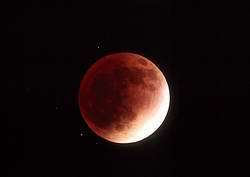
The last eclipse of 2004 occurs on the evening of Wednesday, October 27 (in Europe, the eclipse occurs during the early morning hours of Thursday, October 28). This event is a total eclipse of the Moon which will be visible from North and South America as well as Europe, Africa and Antarctica. During such an eclipse, the Moon's disk can take on a dramatically colorful appearance from bright orange to blood red to dark brown and (rarely) very dark gray.
October's lunar eclipse is well-placed for North and South America as well as western Europe and Africa. From the United States, the eastern two-thirds of the country will see the entire eclipse (weather permitting). In the western third of the USA, the faint penumbral phase begins before moonrise but this is the least interesting and dramatic part of the eclipse. The more important and photogenic partial and total phases will be visible from all of North America with the exception of Alaska. From the Alaskan panhandle, the partial phases begin at moonrise, but further west the Moon will rise during totality.
Canada also witnesses the entire eclipse as does Central and South America. From western Europe, the eclipse occurs during the early morning hours of Wednesday, October 28. The Moon sets during totality from East Africa, the Middle East and central Asia. India and western China will only see the early penumbral stages before the Moon sets. Further east, none of the eclipse is visible from Japan, eastern China, southeast Asia, Indonesia, Australia or New Zealand.
The last eclipse of the year is another total lunar eclipse. This time, the event will be well placed for North Americans. The eclipse occurs at the ascending node of Luna's orbit in southern Aries. Since the Moon is 5.6 days shy of apogee, it will appear 7% smaller (= 30.6 arc-minutes) than it was during May's eclipse. The Moon's trajectory takes it deep into the northern umbral shadow resulting in a total eclipse which lasts 1 hour 21 minutes. At mid-totality, the Moon's southern limb is a mere 0.7 arc-minutes from the umbra's centre.
In contrast, the northern limb is 9.5 arc-minutes from the umbra's edge and 31.3 arc-minutes from its centre. Since different parts of the Moon will probe radically different portions of Earth's umbral shadow, a large variation in shadow brightness can be expected. The totally eclipsed Moon will appear to have a bright rim along its northern edge. Observers are encouraged to estimate the Danjon value at mid-totality.
The penumbral phase of October's eclipse begins at 00:06 UT, but most observers will not be able to visually detect the shadow until about 00:45 UT. A timetable for the major phases of the eclipse is as follows:
Penumbral Eclipse Begins: 00:05:35 UT
Partial Eclipse Begins: 01:14:25 UT
Total Eclipse Begins: 02:23:28 UT
Greatest Eclipse: 03:04:06 UT
Total Eclipse Ends: 03:44:43 UT
Partial Eclipse Ends: 04:53:44 UT
Penumbral Eclipse Ends: 06:02:44 UT
At the instant of mid-totality (03:04 UT), the Moon will stand near the zenith for observers in the southern Caribbean. At that time, the umbral eclipse magnitude will be 1.313. Most of North America will be treated to the entire eclipse. However, the penumbral phases will already be in progress at moonrise for observers in the western States and Canada. Eastern Alaska will catch totality just after moonrise, but observers in the southwestern corner of the state will see the Moon rise already in total eclipse.
Various stages of the eclipse are in progress at moonset for observers throughout much of Asia and Africa. However, eastern and southeast Asia as well as Australia will miss the entire event because it begins after moonset.
Source: NASA


