Research about plant viruses could lead to new ways to improve crop yields
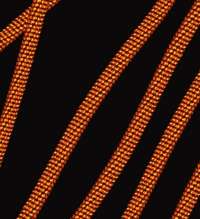
(PhysOrg.com) -- An interdisciplinary group of scientists has obtained the first detailed information about the structure of the most destructive group of plant viruses known: flexible filamentous viruses.
The cost of worldwide crop losses due to plant diseases is estimated at $60 billion annually. Although there are no good estimates of the cost of plant viruses alone, the viruses are generally considered to be the second greatest contributor to those losses (after fungi). The 300-plus species of flexible filamentous viruses are responsible for more than half of all virus damage.
The findings are published in the October 1 issue of the Journal of Virology and could lead to new ways to protect crop plants from these viruses. The structural information that the researchers have obtained may also benefit researchers interested in using viruses as agents of biotechnology to coax plants to produce other useful products, such as pharmaceuticals.
"These are very important plant viruses, and we knew almost nothing about their detailed structure before these studies," says Gerald Stubbs, the professor of biological sciences at Vanderbilt University who directed the study. "Their flexibility made them very difficult to analyze."
The project took more than five years to complete and required the combined skills of scientists from Vanderbilt, the Department of Energy's Brookhaven National Laboratory and Argonne National Laboratory, Boston University, Illinois Institute of Technology and the University of Kentucky using a combination of complementary imaging techniques. The result of this effort was determination of the low-resolution structures of two species of flexible filamentous viruses: soybean mosaic virus and potato virus X.
Amy Kendall, Michele McDonald, Wen Bian, Timothy Bowles, Sarah Baumgarten, Jian Shi and Phoebe Stewart from Vanderbilt; Esther Bullitt from Boston University School of Medicine; David Gore and Thomas Irving from Illinois Institute of Technology; Wendy Havens and Said Ghabrial from the University of Kentucky and Joseph Wall from Brookhaven National Laboratory all contributed to the study.
The researchers found that the external protein coats of the two viruses are extremely similar even though they come from two different viral families, Potyviridae and Flexiviridae.
"Although the two viruses are unrelated, they have the same outer protein coat," says Stubbs. "Sometime in the past, a member of one family must have obtained the coat protein gene from a member of the other family, and it worked so well that pretty soon it was everywhere."
The exchange of genes between different viruses is a well-known phenomenon and generally takes place when two viruses invade the same host, Stubbs says. According to the scientist, this makes it quite likely that a third family of flexible filamentous viruses, the Closteroviridae, has the same protein coat as well.
"Actually, the coat protein is not particularly good at protecting the genome," says Stubbs. "It must confer some evolutionary advantage, but we don't know what that might be."
The viruses are much too small to see with an optical microscope. So the scientists had to use a combination of imaging techniques — cryo-electron microscopy at Vanderbilt, X-ray diffraction at Argonne and scanning transmission electron microscopy (STEM) at Brookhaven – in order to identify the two structures.
"These techniques are very complementary," says Stubbs. "People have been trying to get this structural work started for decades, more than 40 years. It's been very difficult and there have been a number of obstacles, including the fact that it's very hard to make good samples of these viruses."
Even after Stubbs and his colleagues figured out how to make good samples and analyzed them using X-ray diffraction and traditional electron microscopy, there were a number of ambiguities in the results. Brookhaven's STEM technique provided the definitive answers. Although it could not determine the structure of the viral protein coat directly, STEM was able to put boundaries on the number of molecules in each "turn" of the spiral-shaped structure, and this allowed the scientists to select the correct structure from the alternatives they had come up with using the other techniques.
Some potential applications of these results include engineering molecules based on the viral structure that interfere with the viruses' ability to infect plants. Another possibility would be to introduce modified versions of viruses or to coat protein genes into a plant to protect it from viral and insect attacks. Yet another possible application would be to use modified viruses to introduce genes that instruct plants to make other useful products — for example, antibiotics or other drugs.
Provided by Vanderbilt University


