Taking the bite out of shark DNA
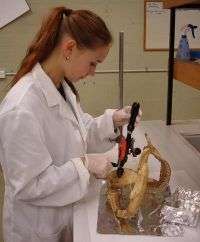
Macquarie University marine scientist Heidi Ahonen.
(PhysOrg.com) -- Extracting shark DNA has been somewhat of a challenge in the past, with scientists having to overcome the obvious hurdles associated with carrying out biopsies on live and rather uncooperative specimens.
Now, two Macquarie University marine scientists, Heidi Ahonen and Dr Adam Stow, have come up with a way of extracting the DNA without disturbing sharks in the wild - by taking samples from their old teeth.
Extracting DNA from sharks is not as simple as with other animals, given that they do not have the bony skeleton that is essential in order for the traditional extraction method to work.
Thanks to the unique ability sharks have to replace their teeth throughout their lifetime, however, old teeth may be collected from the sea floor in areas where sharks are known to aggregate.
Other DNA sources could include trophy jaws and teeth found in museums and private collections.
"Sadly, trophy jaws and teeth from sharks are relatively commonplace, whereas living sharks are becoming increasingly rare," Ahonen said, when interviewed by Nature News.
"This method allows information locked away within the teeth and jaws to be exploited to assist with conservation management."
Ahonen and Stow use a hand drill to extract a small amount of material from a shark's tooth or jaw. They then combine the material with a mixture of detergents and enzymes in order to release the DNA.
The new extraction technique will assist the marine science team at Macquarie in their study of grey nurse sharks and variations in shark genetics over time.
Ahonen and Stow's research has been published in the Journal of Fish Biology.
Provided by Macquarie University
-
From lemons to lemonade: Reaction uses carbon dioxide to make carbon-based semiconductor,
33 comments
-
Thioridazine kills cancer stem cells in human while avoiding toxic side-effects of conventional cancer treatments,
3 comments
-
SpaceX private rocket blasts off for space station (Update),
42 comments
-
Landmark calculation clears the way to answering how matter is formed,
55 comments
-
Research team claims to have found evidence Lake Cheko is impact crater for Tunguska Event,
18 comments
More news stories
Manufacturing genes to attack flu virus
An international research team has manufactured a new protein that can combat deadly flu epidemics.
11 hours ago |
not rated yet |
0
|
Scientist: Evolution debate will soon be history
(AP) -- Richard Leakey predicts skepticism over evolution will soon be history. Not that the avowed atheist has any doubts himself.
May 26, 2012 |
3.4 / 5 (22) |
98
More plant species responding to global warming than previously thought
(Phys.org) -- Far more wild plant species may be responding to global warming than previous large-scale estimates have suggested.
May 22, 2012 |
4.6 / 5 (14) |
18
|
For monogamous sparrows, it doesn't pay to stray (but they do it anyway)
It's quite common for a female song sparrow to stray from her breeding partner and mate with the male next door, but a new study shows that sleeping around can be costly.
May 22, 2012 |
5 / 5 (2) |
8
|
Thousands of shellfish found dead in Peru
Thousands of crustaceans were found dead off the coast of Lima following the mystery mass death of dolphins and pelicans, the Peruvian Navy said Friday.
May 26, 2012 |
4.7 / 5 (7) |
7
Stunning image of smallest possible five-ringed structure
Scientists have created and imaged the smallest possible five-ringed structure about 100,000 times thinner than a human hair and you'll probably recognise its shape.
'Unzipped' carbon nanotubes could help energize fuel cells, batteries
Multi-walled carbon nanotubes riddled with defects and impurities on the outside could replace some of the expensive platinum catalysts used in fuel cells and metal-air batteries, according to scientists at ...
Change in developmental timing was crucial in the evolutionary shift from dinosaurs to birds: study
At first glance, it's hard to see how a common house sparrow and a Tyrannosaurus Rex might have anything in common. After all, one is a bird that weighs less than an ounce, and the other is a dinosaur that ...
Computer model used to pinpoint prime materials for efficient carbon capture
When power plants begin capturing their carbon emissions to reduce greenhouse gases and to most in the electric power industry, it's a question of when, not if it will be an expensive undertaking.
T cells 'hunt' parasites like animal predators seek prey, study shows
By pairing an intimate knowledge of immune-system function with a deep understanding of statistical physics, a cross-disciplinary team at the University of Pennsylvania has arrived at a surprising finding: T cells use a movement ...
Yale study concludes public apathy over climate change unrelated to science literacy
Are members of the public divided about climate change because they don't understand the science behind it? If Americans knew more basic science and were more proficient in technical reasoning, would public consensus match ...