Insect warning colors aid cancer and tropical disease drug discovery
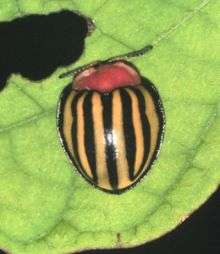
Brightly colored beetles or butterfly larvae nibbling on a plant may signal the presence of chemical compounds active against cancer cell lines and tropical parasitic diseases, according to researchers at Smithsonian's Tropical Research Institute in Panama. Such clues could speed drug discovery and provide insight into the ecological relationships between tropical-forest plants and insects that feed on them. The report is published in the Ecological Society of America's journal Frontiers in Ecology and the Environment.
"These findings are incredibly exciting and important," said Todd Capson, STRI research chemist, who directed the project. "The results of this study could have direct and positive impacts on the future of medical treatment for many diseases around the world."
For this research scientists used plants already known to have anti-cancer compounds; those proven to be active against certain disease-carrying parasites; and plants without such activity. The study showed that beetles and butterfly larvae with bright warning coloration were significantly more common on plants that contained compounds active against certain diseases, such as breast cancer and malaria. There was no significant difference in the number of plain-colored insects between plants with and without activity, according to the study by the Smithsonian's Panama International Cooperative Biodiversity Group Program.
"We put two and two together," said researcher Julie Helson. "We knew that brightly colored insects advertise to their predators that they taste bad and that some get their toxins from their host plants. But because other insects cheat by mimicking the toxic ones, we weren't sure if insect color was really going to work to identify plants containing toxins—it did!" Helson was a student at McGill University when she conducted this research in 2005.
The Smithsonian's PICBG program first demonstrated that theories about chemical defense in rainforest plants—such as the idea that young leaves tend to be richer in defense chemicals—can significantly improve the efficiency and lower the cost of drug discovery, when compared with a random screening approach.
Although the idea that brightly colored insects could facilitate the search for medicinally active plants has been discussed for decades, the concept had never been rigorously tested. This new work at the Smithsonian provides another example of how ecology can contribute to the discovery of novel medicines. The study suggests that a quick screen for insects with warning coloration on tropical plants may increase the efficiency of the search for compounds active against cancer and tropical parasitic disease by four-fold. "It's very gratifying to see that it works in the field." said Capson. "I am hopeful that other investigators will follow our lead and test our theory that insects can lead us to plants with disease-fighting properties."
This work also demonstrates that protecting tropical forests¯not just the insects and plants, but at every level—has the potential to provide immeasurable benefits to human health.
Source: Smithsonian Tropical Research Institute


