First DNA molecule made almost entirely of artificial parts
Jul 07, 2008
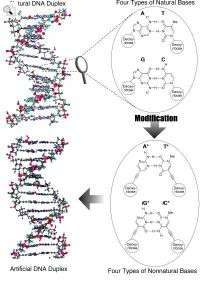
Scientists are reporting synthesis of the world's first DNA molecule made almost of entirely artificial parts. The discovery could be used in the fields of gene therapy and other futuristic high-tech advances, such as nano-sized computers. Courtesy of Masahiko Inouye

Chemists in Japan report development of the world's first DNA molecule made almost entirely of artificial parts. The finding could lead to improvements in gene therapy, futuristic nano-sized computers, and other high-tech advances, they say. Their study is scheduled for the July 23 issue of the Journal of the American Chemical Society.

In the new study, Masahiko Inouye and colleagues point out that scientists have tried for years to develop artificial versions of DNA in order to extend its amazing information storage capabilities.

As the genetic blueprint of all life forms, DNA uses the same set of four basic building blocks, known as bases, to code for a variety of proteins used in cell functioning and development. Until now, scientists have only been able to craft DNA molecules with one or a few artificial parts, including certain bases.

The researchers used high-tech DNA synthesis equipment to stitch together four entirely new, artificial bases inside the sugar-based framework of a DNA molecule. This resulted in unusually stable, double-stranded structures resembling natural DNA.

Like natural DNA, the new structures were right-handed and some easily formed triple-stranded structures. The unique chemistry of these structures and their high stability offer unprecedented possibilities for developing new biotech materials and applications, the researchers say.

Link: dx.doi.org/10.1021/ja801058h

Source: American Chemical Society

Explore further: Attacking MRSA with metals from antibacterial clays

add to favorites email to friend print save as pdf

Related Stories

Reverse extinction: Should we redo the dodo?

Apr 22, 2013

Woolly mammoths stomp through the Siberian tundra as the giant moa strides the forest floor of New Zealand and Tasmania's dog-like "tigers" stalk their prey under the cover of night. This is not a snapshot ...

Study reveals secrets of bacterial slime

Apr 12, 2013

(Phys.org) —Newcastle University scientists have revealed the mechanism that causes a slime to form, making bacteria hard to shift and resistant to antibiotics.

Recommended for you

Attacking MRSA with metals from antibacterial clays

19 hours ago

In the race to protect society from infectious microbes, the bugs are outrunning us. The need for new therapeutic agents is acute, given the emergence of novel pathogens as well as old foes bearing heightened antibiotic resistance.

Beautiful 'flowers' self-assemble in a beaker

May 16, 2013

By simply manipulating chemical gradients in a beaker of fluid, materials scientists at Harvard have found that they can control the growth behavior of crystals to create precisely tailored structures—such ...

Reading the unreadable

May 16, 2013

Pioneering X-ray technology is making it possible to read fragile rolled-up historical documents for the first time in centuries.

Keeping fruit, vegetables and cut flowers fresh longer

May 15, 2013

New technology offers the promise of reducing billions of dollars of losses that occur each year from the silent, invisible killer of fruits, vegetables and cut flowers—a gas whose effects are familiar to everyone who has ...

User comments : 2

Adjust slider to filter visible comments by rank

Display comments: newest first

thales
3 / 5 (4) Jul 07, 2008
Triple-stranded DNA? Shades of "The Fifth Element."

Deano
not rated yet Jul 09, 2008
"Triple-stranded" artificial DNA? Wow. I wonder if that would be an actual improvement on the original two-stranded DNA. Imagine if it really IS an improvement in one way or another. Improving on our most basic of building blocks for every living thing on this Earth. As far as I know, DNA as it's structured as now, is the best possible way nature found to store and re-distibute information, with it's own style of commands to set forth making life with that information. It's been tried-and-true, tested and re-tested, trial-and-error, all that stuff. The way DNA is now is a result of millions of years and an unimaginable number of attempts at building life. It works. Imagine if we can improve on it simply bu adding a third strand or something else just as easily imagined. We can now re-arrange the structure. What if DNA is just the most basic way of creating life, and it really is ready to be improved upon? My mind goes crazy with the prospect that we might be able to take a shortcut in the quest to master DNA design/understanding, by simply playing around with the way a DNA strand is built. It very well could be that DNA is completely improvable, and very easy to do so as long as we can master the process of manipulating the molecules, and from what it says in this article, it looks like we're half-way there if not further. Imagine that. What could we do? What improvements could be made? If we COULD store many more times information than the present way does in a single DNA structure, what would that do? What does it mean? Super-creatures? More detailed creatures? If long eyelashes are written into present-form DNA structures, what would extra information accomplish? Longer lashes with a smoother surface? Longer lashes with STRIPES? Could we then add space in our brains to store more random-access-memory capabilities? By simply adding certain extra info in the brain section of the DNA instructions, could we be able to remember many different things at the same time and not realize how complex that notion is, like it's second nature to us? Better than we could now? Storing more information on a DNA structure, or re-tooling how it is laid-out, sends my mind spinning. The possiblitites seem endless to me. Could we actually infuse metallic structuring in with human flesh as it is today? Could we make ourselves impenitrable by mixing carbon-fiber molecule iformation in with our skin molecule information - on the same DNA structure? We might have to do that particular thing a different way, say for instance adding extra structures that act as fusing DNA for both skin and metal. However it's done, it all seems possible now with this new way of messing with the DNA. Just - wow. Then of course there is the "If we COULD, SHOULD we?" question. Should the military be allowed to have info like this? Could it be used against us? All the fears we already have with possible cloning and gene manipulation (blonde-haired, blue-eyed, high-foreheaded Nazi clones), PLUS now the added possiblity of DNA mutation and the molecule-infusing like I brought up here in this commentary, like adding metal with skin or deepening our brain capabilities. More to worry about, but lots more to dream about too.

More news stories

Attacking MRSA with metals from antibacterial clays

In the race to protect society from infectious microbes, the bugs are outrunning us. The need for new therapeutic agents is acute, given the emergence of novel pathogens as well as old foes bearing heightened antibiotic resistance.

Beautiful 'flowers' self-assemble in a beaker

By simply manipulating chemical gradients in a beaker of fluid, materials scientists at Harvard have found that they can control the growth behavior of crystals to create precisely tailored structures—such ...

Making gold green: New non-toxic method for mining gold

Northwestern University scientists have struck gold in the laboratory. They have discovered an inexpensive and environmentally benign method that uses simple cornstarch—instead of cyanide—to isolate gold from raw materials ...

Galaxy's Ring of Fire

Johnny Cash may have preferred this galaxy's burning ring of fire to the one he sang about falling into in his popular song. The "starburst ring" seen at center in red and yellow hues is not the product of ...

Yahoo Japan suspects 22 million IDs stolen

Yahoo Japan Corp. has said it suspects up to 22 million user IDs may have been stolen during an unauthorised attempt to access the administrative system of its Yahoo! Japan portal.