Lavas from Hawaiian volcano contain fingerprint of planetary formation
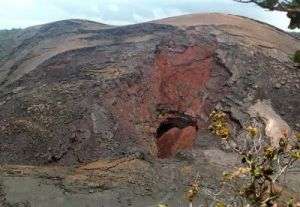
Hikers visiting the Kilauea Iki crater in Hawaii today walk along a mostly flat surface of sparsely vegetated basalt. It looks like parking lot asphalt, but in November and December 1959, it emitted the orange glow of newly erupted lava.
Now, a precision analysis of lava samples taken from the crater is giving scientists a new tool for reconstructing planetary origins. The results of the analysis, by the University of Chicago's Nicolas Dauphas and his associates, will be published in the June 20 issue of the journal Science.
A close examination of iron isotopes—the slight variations the element displays at the subatomic level—can tell planetary scientists more about the formation of crust than they previously thought, according to Dauphas and co-authors Fang-Zhen Teng of the University of Arkansas and Rosalind T. Helz of the U.S. Geological Survey.
If applied to a variety of terrestrial and extraterrestrial basalts, including meteorites from Mars and the asteroids, the method could provide more definitive evidence for a scientifically popular idea that the moon was born from a giant collision between Earth and another large object, Dauphas said.
As the lava in Kilauea Iki crater cooled and solidified, the content of its iron isotopes evolved with time. "A good analogy is putting a bucket of salty water in your freezer and monitoring what happens to the salt concentration in the water as the ice forms," Dauphas said.
The finding contradicts the widely held view that isotopic variations occur only at relatively low temperatures, and only in lighter elements, such as oxygen. But Dauphas and his associates were able to measure isotopic variations as they occur in magma at temperatures of 1,100 degrees Celsius (2,012 degrees Fahrenheit).
Previous studies of basalt found little or no separation of iron isotopes, but those studies focused on the rock as a whole, rather than its individual minerals. "We analyzed not only the whole rocks, but the separate minerals," Teng said. In particular, they analyzed olivine crystals, better known as peridot in the jewelry world.
The June 20 Science article is the first publication based on data collected and analyzed with the help of a new instrument in Dauphas's Origins Laboratory. The instrument, a plasma source mass spectrometer funded by the National Aeronautics and Space Administration and the University of Chicago, separates ions (charged particles) according to their masses. These ions are formed in a plasma of argon gas within the instrument at a temperature of nearly 14,000 degrees Fahrenheit (8,000 degrees Kelvin, hotter than the sun's surface).
Isotopic studies have a long history at the University of Chicago. Harold Urey, who received the 1934 Nobel Prize in chemistry, established the principles governing isotopic variations as a faculty member at Chicago in the 1940s and 1950s, Dauphas said.
The researchers selected Kilauea Iki for their study because scientists have drilled it for samples multiple times as it cooled over the years. This sequence of samples makes the lava lake a perfect site for studying differentiation—the separation of minerals and elements as magma cools and hardens.
"Our work opens up exciting avenues of research," Dauphas said. "We can now use iron isotopes as fingerprints of magma formation and differentiation, which played a role in the formation of continents."
Source: University of Chicago


