Worldwide mission to solve iron deficiency
Jun 11, 2008
Worldwide mission to solve iron deficiency
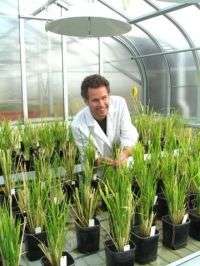
Dr. Alex Johnson is the lead investigator in a project to increase iron content in rice and other cereal grains. Credit: Cobi Smith

A University of Adelaide researcher will lead an Australian project to help address the world's biggest nutritional deficiency – lack of iron.

Dr Alex Johnson has been awarded nearly $300,000 to work with the Bill Gates-funded HarvestPlus Challenge Program to increase iron content in rice and other cereal grains.

More than two billion people – or 30% of the world's population – suffer from iron deficiency, which can cause anaemia, poor mental development, fertility problems and a depressed immune system.

Dr Johnson, who is based at the Australian Centre for Plant Functional Genomics at the Waite Campus, will work on increasing iron content in cereal foods by improving the delivery of iron from the leaf to the seed.

"Iron content is quite low in cereal grains because although iron is present in a plant's leaves, very little of that iron is transported to the seed, which is the part that is consumed by humans.

"We know of several proteins that move iron around in a plant so it is a matter of increasing the flow of iron into a seed tissue called endosperm, which survives the milling and polishing process."

If this can be achieved, the benefits to developing countries in particular will be enormous, Dr Johnson says.

Rice and wheat, the two most widely consumed cereals in developing countries, transport only a small fraction of iron to the developing grain – 5% for rice and 20% for wheat. Furthermore, the small amount of iron that is retained accumulates almost exclusively in the outer layers, which are removed during the milling process so that grain can be stored for long periods.

"In the western world we can get around this problem by adding various compounds to flour to make it rich in iron. But iron fortification of flour is only economical for developed countries. Poor nations can't afford this so we have to find a sustainable way of increasing iron in the milled seed."

Higher iron content could also lower the production costs of many Australian farmers by reducing or eliminating the need for iron fortification of wheat flour.

Source: University of Adelaide

Explore further: Researchers conduct first genomic survey of human skin fungal diversity

add to favorites email to friend print save as pdf

Related Stories

Insects: A must for a protein-rich diet

May 14, 2013

Arnold van Huis is an expert on tropical insects specialised in pest management and biological control based at Wageningen University. He advocates growing insects as feed for livestock and for human consumption. Here, van ...

North Atlantic seaweed is safe to eat

Apr 30, 2013

Seaweed has been eaten for thousands of years by people all over the world, and it can be considered a tasty and healthy food item. This is the conclusion from professor Ole G. Mouritsen, Department of Physics, Chemistry ...

Research shows great promise for millet grains

Apr 17, 2013

Climate change, water scarcity, increasing world population, and rising food prices are only some of the socioeconomic factors that threaten agriculture and food security worldwide, especially for disadvantaged populations ...

Cyberlinguistics: Recording the world's vanishing voices

Mar 12, 2013

Of the 7,000 languages spoken on the planet, Tembé is at the small end with just 150 speakers left. In a few days, I will head into the Brazilian Amazon to record Tembé – via specially-designed technology ...

Recommended for you

Do songbirds hold key to stuttering?

2 hours ago

A tiny Australian songbird may hold the answer to discovering the biological source of stuttering, which affects 3 million Americans and is notoriously difficult to treat.

Drought makes Borneo's trees flower at the same time

5 hours ago

Tropical plants flower at supra-annual irregular intervals. In addition, mass flowering is typical for the tropical forests in Borneo and elsewhere, where hundreds of different plant timber species from the ...

User comments : 0

More news stories

Do songbirds hold key to stuttering?

A tiny Australian songbird may hold the answer to discovering the biological source of stuttering, which affects 3 million Americans and is notoriously difficult to treat.

Coral reefs 'ruled by earthquakes and volcanoes'

(Phys.org) —Titanic forces in the Earth's crust explain why the abundance and richness of corals varies dramatically across the vast expanse of the Indian and Pacific Oceans, a world-first study from the ...

Facebook joins Web freedom group

Facebook on Wednesday became a full member of the Global Network Initiative, a non-governmental organization promoting Internet freedom and privacy rights.