Research uncovers the hidden world of turtles
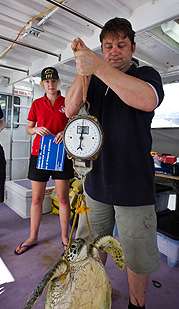
The frog may be the environmental indicator of the land, but University of Queensland researchers reckon when it comes to the sea, we should look to the turtle.
Dr Mark Flint, from UQ's School of Veterinary Science, said turtles may be an amazingly good indicator of the health of our coastline.
“Their declining numbers in Moreton Bay and other key areas around the world are really telling us something is wrong,” Dr Flint said.
He said part of the problem also stems from not knowing enough about what makes a turtle tick and his research hopes to establish health measurements for marine turtles for the first time in Australia.
“Most of the current research centres around surveillance of turtle numbers and declining population,” he said.
“What we are trying to do for the first time is establish what is clinically ‘normal' for the health of a turtle.
“By getting that basis for a health assessment, we may then be able to determine the diseases affecting turtles and provide better ways of treating the sick and injured ones.”
He said current health treatments for turtles were very hit and miss, despite the dedicated work of many rescue operations such as Sea World, Australia Zoo and Underwater World.
“We find many turtles that are successfully rehabilitated by vets, often die when released back into the wild and we have very little idea why,” he said.
“Hopefully our research will open up new insights and help us to help the turtles more.”
Dr Flint said he was working closely with the man widely credited as one of the world's leading turtle researchers Dr Col Limpus.
Dr Limpus, who is an Adjunct Associate Professor in the School of Veterinary Science, president of the International Sea Turtle Society and Chief Scientist with the Environmental Protection Agency (EPA), has been researching turtles for more than 40 years and said this new research would be a boon to his work.
“Without some understanding of the health of turtles, we can have difficulty in correctly identifying causes of their decline,” he said.
“We know a lot about cattle and sheep because humans have been working with them for thousands of years, but with sea turtles it really has only been the last 50 years that we have been serious about understanding their function.”
Dr Flint's research saw him take part in the annual turtle rodeo in Moreton Bay earlier this month, where he worked alongside researchers from Sea World and the EPA.
Source: University of Queensland


