Turning fungus into fuel
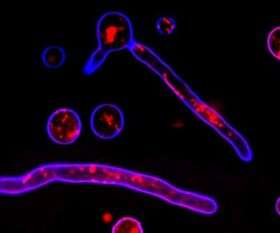
A spidery fungus with a voracious appetite for military uniforms and canvas tents could hold the key to improvements in the production of biofuels, a team of government, academic and industry researchers has announced.
In a paper published today in Nature Biotechnology, researchers led by Los Alamos National Laboratory and the U.S. Department of Energy Joint Genome Institute announced that the genetic sequence of the fungus Tricoderma reesei has uncovered important clues about how the organism breaks down plant fibers into simple sugars.
The finding could unlock possibilities for industrial processes that can more efficiently and cost effectively convert corn, switchgrass and even cellulose-based municipal waste into ethanol. Ethanol from waste products is a more-carbon-neutral alternative to gasoline.
The fungus T. reesei rose to dubious fame during World War II when military leaders discovered it was responsible for rapid deterioration of clothing and tents in the South Pacific. Named after Dr. Elwyn T. Reese, who, with colleagues, originally isolated the hungry fungus, T. reesei was later identified as a source of industrial enzymes and a role model for the conversion of cellulose and hemicellulose—plant fibers—into simple sugars.
The organism uses enzymes it creates to break down human-indigestible fibers of plants into the simplest form of sugar, known as a monosaccharide. The fungus then digests the sugars as food.
Researchers decoded the genetic sequence of T. reesei in an attempt to discover why the deep green fungus was so darned good at digesting plant cells. The sequence results were somewhat surprising. Contrary to what one might predict about the gene content of a fungus that can eat holes in tents, T. reesei had fewer genes dedicated to the production of cellulose-eating enzymes than its counterparts.
“We were aware of T. reesei’s reputation as producer of massive quantities of degrading enzymes, however we were surprised by how few enzyme types it produces, which suggested to us that its protein secretion system is exceptionally efficient,” said Los Alamos bioscientist Diego Martinez (also at the University of New Mexico), the study’s lead author. The researchers believe that T. reesei’s genome includes “clusters” of enzyme-producing genes, a strategy that may account for the organism’s efficiency at breaking down cellulose.
On an industrial scale, T. reesei could be employed to secrete enzymes that can be purified and added into an aqueous mixture of cellulose pulp and other materials to produce sugar. The sugar can then be fermented by yeast to produce ethanol.
“The sequencing of the Trichoderma reesei genome is a major step towards using renewable feedstocks for the production of fuels and chemicals,” said Joel Cherry, director of research activities in second-generation biofuels for Novozymes, a collaborating institution in the study. “The information contained in its genome will allow us to better understand how this organism degrades cellulose so efficiently and to understand how it produces the required enzymes so prodigiously. Using this information, it may be possible to improve both of these properties, decreasing the cost of converting cellulosic biomass to fuels and chemicals.”
Source: Los Alamos National Laboratory


