Global Warming Linked to Caribou-Calf Mortality
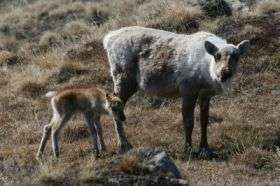
Fewer caribou calves are being born and more of them are dying in West Greenland as a result of a warming climate, according to Eric Post, a Penn State associate professor of biology. Post, who believes that caribou may serve as an indicator species for climate changes including global warming, based his conclusions on data showing that the timing of peak food availability no longer corresponds to the timing of caribou births.
The study, which was conducted in collaboration with Mads Forchhammer at the University of Aarhus in Denmark, will be published in the 12 July 2008 issue of the Philosophical Transactions of the Royal Society of London.
Caribou -- which are closely related to wild reindeer -- are dependent on plants for all their energy and nutrients. Throughout the long Arctic winter, when there is no plant growth, they dig through snow to find lichens; however, in spring they rapidly switch to grazing on the new growth of willows, sedges, and flowering tundra herbs. As the birth season approaches, they are cued by increasing day length to migrate into areas where this newly-emergent food is plentiful.
But this routine, which has worked for millennia, is faltering because caribou are unable to keep pace with certain changes that have occurred as a result of global warming. When the animals arrive at their calving grounds now, pregnant females find that the plants on which they depend already have reached peak productivity and have begun to decline in nutritional value. According to Post, the plants -- which initiate growth in response to temperature, not day length -- are peaking dramatically earlier in response to rising temperatures. "Spring temperatures at our study site in West Greenland have risen by more than 4 degrees Celsius over the past few years," said Post. "As a result, the timing of plant growth has advanced, but calving has not."
The phenomenon, called trophic mismatch, is a predicted consequence of climate change, in which the availability of food shifts in response to warming, whereas the timing of demand for those resources does not keep pace. Trophic mismatches have been documented in birds -- with the most famous example being the study on Dutch birds and their caterpillar prey that was highlighted in former Vice President Al Gore's film An Inconvenient Truth -- but, until now, the phenomenon had not been observed in terrestrial mammals. "Our work is the first documentation of a developing trophic mismatch in a terrestrial mammal as a result of climatic warming," said Post. "And the rapidity with which this mismatch has developed is eye-opening, to say the least."
While Post and Forchhammer think it is possible that caribou will respond to a warming climate by advancing the timing of their reproduction, they are not convinced that the species will be able to compensate fully for the rapid rates of temperature change that are yet to come. "They're a little behind the game already and future warming will make it even harder for them to catch up," said Post. "This factor is just one of many related to climate change -- such as thaw-freeze cycles, ice-crust formation, and severe storms -- that may make it difficult for caribou populations to persist at their former abundance."
Source: Penn State


