It's a unisex brain with specific signals that trigger 'male' behavior
Apr 30, 2008
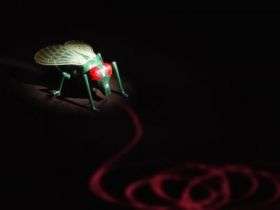
Cartoon of Remote-Controlled Fly
Cartoon of remote-controlled fly. Credit: G.Miesenboeck

Research by Yale scientists shows that males and females have essentially unisex brains — at least in flies — according to a recent report in Cell designed to identify factors that are responsible for sex differences in behavior.

The researchers showed that a courting “song and dance” routine that only male flies naturally perform — one wing is lifted and wiggled to make a humming “song” — can also be triggered in female flies by artificially stimulating particular brain cells that are present in both sexes. It isn’t what you’ve got — it’s how you use it, the authors say.

“It appears there is a largely bisexual or ‘unisex brain.’ Anatomically, the differences are subtle and a few critical switches make the difference between male and female behavior,” said senior author Gero Miesenboeck, formerly of Yale University and now at the University of Oxford.

According to the authors, most male animals have to perform elaborate courtship displays to try to convince the female that they are worthy mates. Their study was designed to see what neurons were responsible for behavior in the courtship dance of flies, and how the neural circuits in males and females differed. To do this, they genetically engineered specific neurons in the fly to respond to light. This optical trick allowed them to activate the neural circuits that control the behavior pattern directly.

Using a flash of laser light as a “remote control” for the brain cells, the researchers first identified which nerve cells control the courting behavior in males. Next, they showed that the cells were present and functional in both males and females, even though only males do the song and dance.

“Surprisingly, when the brain cells of female flies were flashed with the laser cue we found that even the female flies that never normally behaved this way, began to sing,” said Dylan Clyne, a Yale post-doctoral associate and primary investigator of the study. “Our work shows that the brains not only look similar but are functionally similar. The females have all the equipment to sing, but normally don’t use it because their song circuit doesn’t get the appropriate activating signals.”

Asked about the relevance of this study to humans, Clyne said, “You have to be careful about how much you can extrapolate from studying flies. But, the basic principle should hold up – that is, the idea that we don’t need big sex-differences in the brain to explain why it seems that men are from Mars and women from Venus.”

The authors’ next goal is finding the controls that set the flies’ brains to the male or female mode. They hope that by studying examples like sex-specific behaviors, they can clarify the still poorly understood relationships between genes, which are the targets of natural selection, and behavior, which is the product of evolution. Ultimately, this line of research could also shed light on how genes underlie behavioral variation and perhaps even specific mental illnesses.

Citation: Cell 133: 354-363 (April 18, 2008).

Source: Yale University

Explore further: Study reveals how fishing gear can cause slow death of whales

add to favorites email to friend print save as pdf

Related Stories

With many parrots endangered, team sequences macaw genome

May 09, 2013

(Phys.org) —In a groundbreaking move that provides new insight into avian evolution, biology and conservation, researchers at Texas A&M University have successfully sequenced the complete genome of a Scarlet ...

Eastern US to be overrun by billions of cicadas (Update)

May 06, 2013

Any day now, billions of cicadas with bulging red eyes will crawl out of the earth after 17 years underground and overrun the East Coast. The insects will arrive in such numbers that people in the southern ...

Europe set to ban bee-killing pesticides (Update)

Apr 29, 2013

The European Commission received the go-ahead Monday to slap a two-year ban across the European Union on the use of pesticides blamed for a sharp decline in bee populations, an EU diplomat said.

Recommended for you

Do songbirds hold key to stuttering?

43 minutes ago

A tiny Australian songbird may hold the answer to discovering the biological source of stuttering, which affects 3 million Americans and is notoriously difficult to treat.

Drought makes Borneo's trees flower at the same time

3 hours ago

Tropical plants flower at supra-annual irregular intervals. In addition, mass flowering is typical for the tropical forests in Borneo and elsewhere, where hundreds of different plant timber species from the ...

Fast new, one-step genetic engineering technology

3 hours ago

A new, streamlined approach to genetic engineering drastically reduces the time and effort needed to insert new genes into bacteria, the workhorses of biotechnology, scientists are reporting. Published in ...

100K Pathogen Genome Project maps first genomes

3 hours ago

(Phys.org) —Striking a blow at foodborne diseases, the 100K Pathogen Genome Project at the University of California, Davis, today announced that it has sequenced the genomes of its first 10 infectious microorganisms, including ...

User comments : 0

More news stories

Do songbirds hold key to stuttering?

A tiny Australian songbird may hold the answer to discovering the biological source of stuttering, which affects 3 million Americans and is notoriously difficult to treat.

Coral reefs 'ruled by earthquakes and volcanoes'

(Phys.org) —Titanic forces in the Earth's crust explain why the abundance and richness of corals varies dramatically across the vast expanse of the Indian and Pacific Oceans, a world-first study from the ...

Coccoliths thrive despite ocean acidification

Ocean acidification is damaging some marine species while others thrive, say scientists. An international team studied the effect of ocean acidification on plankton in the North Sea over the past forty years, ...

Costs to treat stroke in America may double by 2030

Costs to treat stroke are projected to more than double and the number of people having strokes may increase 20 percent by 2030, according to the American Heart Association/American Stroke Association.