Like sweets? You're more like a fruit fly than you think
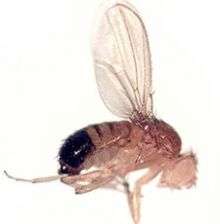
According to researchers at the Monell Center, fruit flies are more like humans in their responses to many sweet tastes than are almost any other species.
The diverse range of molecules that humans experience as sweet do not necessarily taste sweet to other species. For example, aspartame, a sweetener used by humans, does not taste sweet to rats and mice.
However, fruit flies respond positively to most sweeteners preferred by humans, including sweeteners not perceived as sweet by some species of monkeys.
The findings, published in the current issue of the journal Chemical Senses, demonstrate the critical role of environment in shaping the genetic basis of taste preferences and feeding behavior.
“Humans and flies have similar taste responses because they share similar environments and ecological niches, not because their sweet receptors are similar genetically,” notes senior author Paul A.S. Breslin, PhD, a Monell sensory geneticist. “Both are African species, both are omnivorous, and both historically are primarily fruit eaters.”
To compare how molecular structure is related to sweet taste perception in humans and flies, the Monell researchers evaluated how fruit flies respond to 21 nutritive and nonnutritive compounds of varying molecular structure, all of which taste sweet to humans.
Breslin and lead author Beth Gordesky-Gold, PhD, used two behavioral tests to evaluate the flies’ responses to the various sweeteners.
The taste reactivity test measures whether a fly extends its feeding tube, or ‘proboscis,’ to consume a given sweetener. In addition, a two-choice preference test evaluates the flies’ responses to a sweetener by measuring whether they consume it in preference to a control solution (usually water).
The Monell researchers found that fruit flies and humans both respond positively to the same broad range of sweet-tasting molecules.
“The similarity between human and fly responses to sweeteners is astounding, especially in light of the differences in their taste receptors,” notes Gordesky-Gold, a Drosophila (fruit fly) geneticist at Monell.
Sweet receptors belong to a large family of receptors known as G-protein coupled receptors (GPCRs), which are involved in biological processes throughout the body. Human and fly sweet taste GPCRs are presumed to have markedly different structures, an assumption that is based on differences in the genes that code for them.
Since substances will only taste sweet if they are able to bind to and activate a receptor, these two structurally different types of sweet receptors must have similar ‘binding regions’ that fit the same range of molecular shapes.
“That genes could be so divergent in sequence and so similar in physiology and function is truly striking,” says Breslin. “This is a wonderful example of convergent evolution in perceptual behavior, where evolution has taken two different routes to address pressures imposed by shared environment and nutrition.”
Future work will be directed towards modeling how these two structurally different sweet receptors could have highly overlapping sweetener affinities. Such knowledge will increase understanding of how molecules bind to GPCRs, which are targets for many pharmaceutical drugs.
Source: Monell Chemical Senses Center


