Royal corruption is rife in the ant world
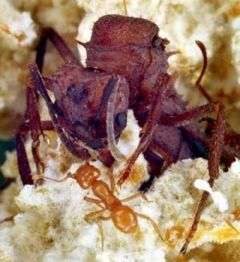
Far from being a model of social co-operation, the ant world is riddled with cheating and corruption – and it goes all the way to the top, according to scientists from the Universities of Leeds and Copenhagen.
Ants have always been thought to work together for the benefit of the colony rather than for individual gain. But Dr Bill Hughes from Leeds’ Faculty of Biological Sciences has found evidence to shatter this illusion.
With Professor Jacobus Boomsma from the University of Copenhagen, he’s discovered that certain ants are able to cheat the system, ensuring their offspring become reproductive queens rather than sterile workers.
“The accepted theory was that queens were produced solely by nurture: certain larvae were fed certain foods to prompt their development into queens and all larvae could have that opportunity,” explains Dr Hughes. “But we carried out DNA fingerprinting on five colonies of leaf-cutting ants and discovered that the offspring of some fathers are more likely to become queens than others. These ants have a ‘royal’ gene or genes, giving them an unfair advantage and enabling them to cheat many of their altruistic sisters out of their chance to become a queen themselves.”
But what intrigued the scientists was that these ‘royal’ genetic lines were always rare in each colony.
Says Dr Hughes: “The most likely explanation has to be that the ants are deliberately taking steps to avoid detection. If there were too many of one genetic line developing into queens in a single colony, the other ants would notice and might take action against them. So we think the males with these royal genes have evolved to somehow spread their offspring around more colonies and so escape detection. The rarity of the royal lines is actually an evolutionary strategy by the cheats to escape suppression by the altruistic masses that they exploit.”
A few times each year, ant colonies produce males and new queens which fly off from their colonies to meet and mate. The males die shortly after mating and the females go on to found new colonies. The researchers are keen to study this process, to determine if their hypothesis is correct and the mating strategy of males with royal genes ensures their rarity, to keep their advantages undetected by their ‘commoner’ counterparts.
However, the scientists’ discovery does prove that, although social insect colonies are often cited as proof that societies can be based on egalitarianism and cooperation, they are not quite as utopian as they appear.
“When studying social insects like ants and bees, it’s often the cooperative aspect of their society that first stands out,” says Dr Hughes. “However, when you look more deeply, you can see there is conflict and cheating – and obviously human society is also a prime example of this. It was thought that ants were an exception, but our genetic analysis has shown that their society is also rife with corruption – and royal corruption at that!”
Source: University of Leeds


