Researchers engineer new polymers to change their stiffness, strength when exposed to liquids
An interdisciplinary team of researchers from the departments of macromolecular science and engineering and biomedical engineering at the Case School of Engineering and the Louis Stokes Cleveland Department of Veterans Affairs Medical Center has published ground-breaking work on a new type of polymer that displays chemoresponsive mechanic adaptability -- meaning the polymer can change from hard to soft plastic and vice versa in seconds when exposed to liquid -- in the March 7, 2008, issue of Science.
Jeffrey R. Capadona, associate investigator at the VA's Advanced Platform Technology (APT) Center, graduate student Kadhiravan Shanmuganathan, and Case Western Reserve University professors and APT investigators Dustin Tyler (biomedical engineering), Stuart Rowan (macromolecular science) and Christoph Weder (macromolecular science) have unveiled a radically new approach for developing polymer nanocomposites which alter their mechanical properties when exposed to certain chemical stimuli.
"We can engineer these new polymers to change their mechanical properties -- in particular stiffness and strength -- in a programmed fashion when exposed to a specific chemical," says Weder, one of the senior authors of the paper.
"The materials on which we reported in Science were designed to change from a hard plastic -- think of a CD case -- to a soft rubber when brought in contact with water," adds Rowan, who has been Weder's partner on the project for almost six years.
"Our new materials were tailored to respond specifically to water and to exhibit minimal swelling, so they don't soak up water like a sponge," saud Shanmuganathan.
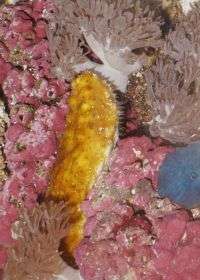
In their new approach, the team used a biomimetic approach -- or mimicking biology -- copying nature's design found in the skin of sea cucumbers.
"These creatures can reversibly and quickly change the stiffness of their skin. Normally it is very soft, but, for example, in response to a threat, the animal can activate its 'body armor' by hardening its skin," explains Capadona, who has a sea cucumber in his aquarium. Marine biologists have shown in earlier studies that the switching effect in the biological tissue is derived from a distinct nanocomposite structure in which highly rigid collagen nanofibers are embedded in a soft connective tissue. The stiffness is mediated by specific chemicals that are secreted by the animal's nervous system and which control the interactions among the collagen nanofibers. When connected, the nanofibers form a reinforcing network which increases the overall stiffness of the material considerably, when compared to the disconnected (soft) state.
Building on their recent success on the fabrication of artificial polymer nanocomposites containing rigid cellulose nanofibers, which earned them the December 2007 cover of Nature Nanotechnology, the team mimicked the architecture nature 'designed' for the sea cucumbers and created artificial materials that display similar mechanical morphing characteristics.
The Case Western Reserve/VA team is specifically interested in using such dynamic mechanical materials in biomedical applications, for example as adaptive substrates for intracortical microelectrodes. These devices are being developed as part of 'artificial nervous systems' that have the potential to help treat patients that suffer from medical conditions such as Parkinson's disease, stroke or spinal cord injuries, i.e., disorders in which the body's interface to the brain is compromised.
A problem observed in experimental studies is that the quality of the brain signals recorded by such microelectrodes usually degrades within a few months after implantation, making chronic applications challenging. One hypothesis for this failure is that the high stiffness of these electrodes, which is required for their insertion, causes damage to the surrounding, very soft brain tissue over time.
"We believe that electrodes that use mechanically adaptive polymer as substrate could alleviate this problem" explains Dustin Tyler, who specializes in neural interfacing and functional electrical stimulation. The development and testing of experimental microelectrodes that involve the new adaptive materials is currently underway. "That's why we designed our first materials to respond to water" explains Weder. "This allows the rigid electrodes to become soft when implanted into the water-rich brain" he adds.
Source: Case Western Reserve University


