Invasion of the cane toads
Feb 27, 2008
Invasion of the cane toads
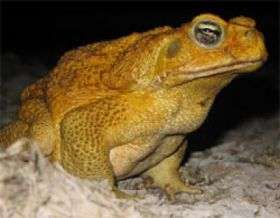
Australian cane toad (Chaunus [Bufo] marinus). Credit: Ben L. Phillips

Why do some invasive species expand rapidly in a new environment while others do not? Scientists from the United States and Australia are beginning to make headway on this question after analyzing how fast cane toads invaded different regions of Australia.

Using over 70 years of data on toad presences collected since their introduction, researchers discovered that cane toads invaded different regions of Australia at dramatically divergent rates. These variable invasion rates appear to be e explained not only by environmental features that facilitate toad movement, but also by the evolution of higher movement rates. Natural selection might cause the evolution of increased movement rates in individuals at the edge of a species' range because the first individuals to arrive can monopolize the best habitats and exclude later arrivals and thus gain an advantage.

"The worrying message from this research is that if control efforts fail and an invasive species spreads across a sufficiently large area," says Mark Urban, "then it may be able to invade a broader region than expected because it has adapted to move across greater distances at the edge of its range."

He adds, "Understanding how environmental and genetic variation affects the movement rates of invading populations will generate better predictions about when an introduced species will arrive in a sensitive ecosystem. Our hope is that this information will help control the expansion of introduced species more effectively in the future."

This research has important implications for the global conservation of endangered species, many of which are threatened by the expanding ranges of introduced plants and animals.

Citation: "A toad more traveled: the heterogeneous invasion dynamics of cane toads in Australia" by Mark C. Urban, Ben L. Phillips, David K. Skelly, and Richard Shine, American Naturalist (171:E134–E148)

Source: University of Chicago

Explore further: City-life changes blackbird personalities, study shows

add to favorites email to friend print save as pdf

Related Stories

Cane toads can be stopped

Dec 12, 2012

It may be possible to stop the spread of can toads into new areas of Australia according to new research published today in the Journal of Applied Ecology.

Myna 'guity of evicting Aussie birds'

Nov 27, 2012

The common myna – popularly known as 'the cane-toad of the air' – has been convicted on new evidence it is pushing Australian native birds out of their home range.

Cocoa remedy for Amazon deforestation?

Jun 14, 2012

A chocolate factory nestled deep in the Amazonian jungle in Brazil's northern state of Para offers a sweet antidote to rainforest deforestation.

Speedy toads advance theory of evolution

Mar 23, 2011

(PhysOrg.com) -- Speed and the mating habits of the Australian cane toad are set to expand the theory of evolution according to research published in the Proceedings of the National Academy of Sciences of t ...

Recommended for you

City-life changes blackbird personalities, study shows

10 hours ago

The origins of a young animal might have a significant impact on its behavior later on in life. Researchers at the Max Planck Institute for Ornithology in Radolfzell, Germany, have been able to demonstrate ...

Origins of 'The Hoff' crab revealed (w/ Video)

10 hours ago

The history of a new type of crab, nicknamed 'The Hoff' because of its hairy chest, which lives around hydrothermal vents deep beneath the Southern Ocean and Indian Ocean, has been revealed for the first ...

User comments : 0

More news stories

Origins of 'The Hoff' crab revealed (w/ Video)

The history of a new type of crab, nicknamed 'The Hoff' because of its hairy chest, which lives around hydrothermal vents deep beneath the Southern Ocean and Indian Ocean, has been revealed for the first ...

Cape Wind gets $200M investment from Danish fund

The Cape Wind offshore wind project has secured a $200 million investment from a Danish pension fund in what the wind farm's president said Tuesday is a milestone for the long-delayed project.