Lemur's evolutionary history may shed light on our own
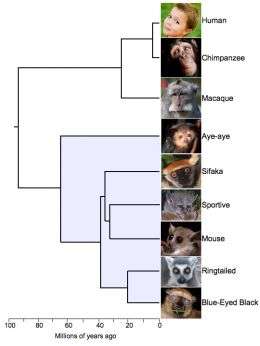
After swabbing the cheeks of more than 200 lemurs and related primates to collect their DNA, researchers at the Duke Institute for Genome Sciences & Policy (IGSP) and Duke Lemur Center now have a much clearer picture of their evolutionary family tree.
Found in nature only on the island nation of Madagascar, off Africa’s southeastern coast, lemurs and their close relatives the lorises represent the sister lineage to all other primates. And that makes lemurs key to understanding what distinguishes us and the rest of our primate cousins from all other animals, according to Julie Horvath, a post-doctoral researcher in the IGSP.
“If we find a trait or characteristic shared between lemurs and other primates, it can tell us what is or isn’t primate-specific and when those traits arose,” said Horvath, who works in the laboratory of IGSP director Huntington Willard.
The new “phylogenomic toolkit” the researchers developed will also play into conservation efforts aimed to save the critically endangered lemurs, by helping to define the number of existing species, said David Weisrock, a post-doctoral researcher working with Duke Lemur Center Director Anne Yoder.
The researchers report their findings in the March 1 issue of Genome Research.
Scientists uncover evolutionary relationships among species based on similarities and differences in their genetic codes. The increasing number of fully sequenced genomes available for major evolutionary groups has allowed resolution of relationships that had been considered unmanageable before.
But except for humans’ close evolutionary ties to chimpanzees, many of the relationships among other apes, monkeys and pre-monkeys called prosimians have remained somewhat murky, according to Horvath.
To find out where Madagascar’s lemurs fit in, the Duke team first needed to develop the tools for comparing sequences from the many lemur species to one another, and to those of other primates including humans.
The researchers identified stretches of DNA sequence held in common between the genomes of the human, the ringtailed lemur and the mouse lemur. These "conserved sequences" served as primers, allowing them to sample comparable bits of sequence across the genomes of the various primate species.
Their analysis confirmed that the first to branch off from the rest of the lemurs, some 66 million years ago, was the aye-aye--a nocturnal primate that taps on trees with its fingers to listen for insects inside, making it Madagascar’s version of a woodpecker. They also resolved the relationships among species within the remaining four evolutionary lineages, which includes a diverse cast of characters: the sifakas, named for the hissing “shee-fak” sound they make; the sportive lemurs, which are strictly nocturnal; the mouse lemurs, the smallest of all living primates; and the many so-called “true lemurs,” including the blue-eyed black lemur (one of only three blue-eyed primates in the world) and the ringtailed lemur, which is often found in zoos.
“By throwing this much data at the problem, we have absolutely confirmed, beyond any statistical doubt, that the spectacular array of lemurs all descended from a single ancestral species,” said Yoder, noting that lemurs account for about 20 percent of primate species and live on less than one percent of the earth’s surface. “It further highlights the importance of Madagascar as a cradle for biodiversity.”
The study lays the groundwork for doing future studies of lemurs and other primates. The methods the group developed for this study can also be applied to understanding evolutionary relationships among other animal groups for which genomic sequences are hard to come by.
Source: Duke University


