A New Clue to the Hypothesis of Life on Mars
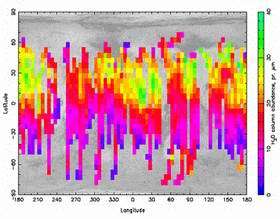
Recent analyses of ESA's Mars Express data reveal that concentrations of water vapour and methane in the atmosphere of Mars significantly overlap. This result, from data obtained by the Planetary Fourier Spectrometer (PFS), gives a boost to understanding of geological and atmospheric processes on Mars, and provides important new hints to evaluate the hypothesis of present life on the Red Planet.
PFS observed that, at 10-15 kilometres above the surface, water vapour is well mixed and uniform in the atmosphere. However, it found that, close to the surface, water vapour is more concentrated in three broad equatorial regions: Arabia Terra, Elysium Planum and Arcadia-Memnonia.
Here, the concentration is two to three times higher than in other regions observed. These areas of water vapour concentration also correspond to the areas where NASA’s Odyssey spacecraft has observed a water ice layer a few tens of centimetres below the surface, as Dr Vittorio Formisano, PFS principal investigator, reports.
Image: This map shows the concentration of water vapour close to the soil around the equatorial region of Mars. The areas of least concentration are in purple, the highest in green.
New in-depth analysis of PFS data also confirms that methane is not uniform in the atmosphere, but concentrated in some areas. The PFS team observed that the areas of highest concentration of methane overlap with the areas where water vapour and underground water ice are also concentrated. This spatial correlation between water vapour and methane seems to point to a common underground source.
Initial speculation has taken the underground ice layer into account. This could be explained by the ‘ice table’ concept, in which geothermal heat from below the surface makes water and other material move towards the surface. It would then freeze before getting there, due to the very low surface temperature (many tens of degrees Celsius below zero).
Further investigations are needed to fully understand the correlation between the ice table and the presence and distribution of water vapour and methane in the atmosphere.
In other words, can the geothermal processes which ‘feed’ the ice table also bring water vapour and other gases, like methane, to the surface? Can there be liquid water below the ice table? Can forms of bacterial life exist in the water below the ice table, producing methane and other gases and releasing them to the surface and then to the atmosphere?
The PFS instrument has also detected traces of other gases in the Martian atmosphere. A report on these is currently under peer review. Further studies will address whether these gases can be linked to water and methane and help answer the unresolved questions. In-situ observations by future lander missions to Mars may provide a more exhaustive solution to the puzzle.
The result is reported today, 20 September, by Dr Vittorio Formisano at the International Mars Conference (19-23 September), organised by the Italian Space Agency (ASI) in Ischia, Italy.
The objective of the PFS instrument is the study, with unprecedented spectral resolution, of temperature fields in the atmosphere, dust, variation and cycle of water and carbon monoxide, vertical distribution of water, soil-atmosphere interactions and minor gaseous species. From this, hints of extant life can be extracted (in terms of the presence of ‘biomarker’ gases and chemical study of atmospheric environmental conditions).
The PFS is an Italian Space Agency instrument, developed by the Istituto di Fisica dello Spazio Interplanetario (IFSI) of the Istituto Nazionale di Astrofisica (INAF), in the framework of ESA's Mars Express mission.
Source: ESA


