March 24, 2006 feature
Disorder helps to 'hyperfocus' waves in time reversal acoustics
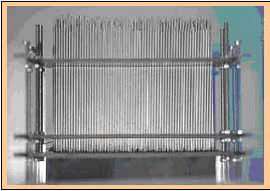
For every burst of sound, there must exist a sound that bursts in reverse, according to the theory of time reversal acoustics. From their discoveries of some surprising characteristics of mediums and frequencies, scientists have gained insight into acoustic time reversal, which could impact applications such as sending confidential messages in cryptography.
Time-reversed focusing is based on the fact that when a wave is played backwards in time, wavelengths will retrace their paths. Although theoretically the overlap should be exact, the actual time reversal mirrors (TRMs) that play back the waves can not “catch” every frequency of the original wave. Scientists know that some media allow acoustic time reversal to occur with higher resolution than other media, and recently physicists from the University of Paris have discovered how disordered and ordered media affect this resolution.
In a study published in Physical Review Letters, physicists A. Tourin, F. Van Der Biest and M. Fink have found that, while sound waves traveling through a disordered medium can focus with high precision, waves traveling through an ordered medium do not have the same ability to focus. The team was also surprised to discover that for a certain type of wave called evanescent waves, an ordered medium exhibits better time compression than a disordered medium.
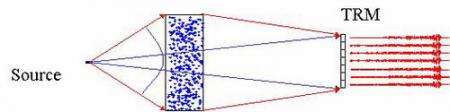
The team used a TRM that consisted of an array of 41 transducers, which recorded the original waves and then focused the waves back to the source. The transducers play the role of microphones and loudspeakers because they act as “reversible” devices.
“The term ‘time reversal’ tells you that the signal captured by the TRM and stored in electronic memories is read in the reverse order before being sent back,” Tourin told PhysOrg.com.
Although the 41 transducers try to capture as many of the original waves within a phononic (vibrating) crystal as possible, several frequencies slip through the cracks, which reduces spatial focusing for the return waves. Sometimes, frequencies that would normally not pass through the TRM can be directed toward the mirror by a medium with large apertures and significant disorder.
In this case, when the 41 transducers try to capture waves propagating through a medium of steel rods arranged randomly in water, the rods scatter and redirect otherwise-lost frequencies into one of the transducers. The ability to catch these misguided frequencies is called “hyperfocusing.” When the physicists observed time reversal in a phononic crystal, however, they did not observe the hyperfocusing effect.
“This is the first time that a time reversal experiment has been performed through a phononic crystal, i.e. a perfectly ordered material,” said Tourin. “The comparison between a phononic crystal and a disordered medium shows that disorder plays a clear role in the so-called ‘hyperfocusing effect.’”
The team of physicists also analyzed time-reversal properties for short-lived evanescent waves that occur at forbidden frequencies in the phononic crystal. The evanescent waves exhibited surprisingly good time compression, showing that – despite the absence of hyperfocusing – time reversal focusing is still possible in highly ordered media.
Since conventional sound waves disperse when traveling through a medium, the possibility of focusing sound waves could have applications in several areas. In cryptography, for example, when sending a secret message, the sender could ensure that only one location would receive the message. Interceptors at other locations would only pick up noise due to unfocused waves. Other potential uses include antisubmarine warfare and underwater communications that benefit from targeted signaling.
Citation: Tourin, A., Van Der Biest, F. and Fink, M. Time Reversal of Ultrasound through a Phononic Crystal. Physical Review Letters 96, 104301 (2006).
By Lisa Zyga, Copyright 2006 PhysOrg.com


