Secret of the carnivorous pitcher plant's slurp -- solved at last
Jan 28, 2008
Secret of the carnivorous pitcher plant's slurp -- solved at last
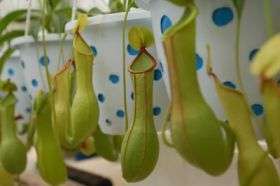
Scientists have deciphered the complex cocktail of digestive and antibacterial enzymes of the carnivorous pitcher plant.Courtesy of Tatsuro Hamada, Ishikawa Prefectural University, Japan

Splash! Ooch! Yum! And so another unsuspecting insect victim of Nepenthes alata (N. alata), commonly known as the carnivorous pitcher plant, falls victim to the digestive fluids at the bottom of the plant's famous cup-shaped leaf. For almost a century, scientists have sought the full chemical recipe for the pitcher plant's fluid.

Japanese scientists now report completely deciphering this complex cocktail of digestive and antibacterial enzymes. Their study is scheduled for the February issue of ACS’ Journal of Proteome Research.

Unlike other plants that absorb nutrients from the soil, carnivorous plants growing in nutrient-poor soils have special organs to capture insects, digest them and absorb the nitrogen and phosphorous their environment sorely lacks. The identity of all the myriad proteins involved in this evolutionary marvel — some of which could have beneficial applications in medicine and agriculture — has been a mystery until now.

Tatsuro Hamada and Naoya Hatano used cutting-edge proteomic analysis to identify all of the components. They isolated and sequenced the proteins, then compared each with existing proteins to find structural matches.

Hamada and Hatano detected seven proteins that exist mainly in the pitcher fluid of N. alata — three of which can only be found in this species — including useful enzymes that may inhibit bacterial growth and rotting as the plant slowly digests its prey.

Source: ACS

Explore further: Biological fitness trumps other traits in mating game

add to favorites email to friend print save as pdf

Related Stories

New language discovery reveals linguistic insights

3 hours ago

A new language has been discovered in a remote Indigenous community in northern Australia that is generated from a unique combination of elements from other languages. Light Warlpiri has been documented by University of Michigan ...

Millions of moths mass on Madrid

10 hours ago

Millions of moths have engulfed Madrid in a population explosion blamed on spring rains, a sudden blast of summer heat and winds that have wafted them in as unwelcome guests to the Spanish capital.

Second Atlantic season tropical depression forms

10 hours ago

Tropical Depression 2 formed in the western Caribbean Sea during the early afternoon hours (Eastern Daylight Time) on June 17. NOAA's GOES-13 satellite captured an image of the storm as it consolidated enough ...

Recommended for you

Biological fitness trumps other traits in mating game

7 hours ago

When a new species emerges following adaptive changes to its local environment, the process of choosing a mate can help protect the new species' genetic identity and increase the likelihood of its survival. ...

Snail genetic tracks reveal ancient human migration

7 hours ago

Some snails in Ireland and the Pyrenees are genetically almost identical, perhaps because they were carried across the Atlantic during an 8000-year-old human migration. The snail genetics tie in with studies ...

World Food Prize goes to 3 biotech scientists

10 hours ago

This year's World Food Prize is going to a Belgian scientist and two researchers in the United States for their innovations that brought the world genetically modified crops.

User comments : 0

More news stories

LA to give every student an iPad; $30M order

Los Angeles' school system, the second largest in the United States, is ordering iPads for all its students, handing Apple a major success in its quest to make the tablet computer a replacement for textbooks.