New coating protects steel and superalloys
Mar 23, 2006
New coating protects steel and superalloys
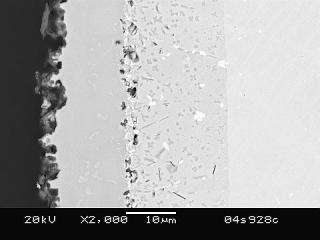
An electron micrograph of a coated 316 stainless steel coupon in cross-section shows the diffusion-reaction layers. Starting from the left hand side of the photo, which is the surface of the steel the following layers are visible: 1) Aluminum oxide outer layer (not visible at lower magnifications) 2) FeAl layer, 3) Fe3Al inner layer, and 4) 316SS.

Researchers at Pacific Northwest National Laboratory have developed a new ceramic-based coating for steel and superalloys that prevents corrosion, oxidation, carburization and sulfidation that commonly occur in gas, liquid, steam and other hostile environments.

The low-cost, easy-to-apply material is available for licensing and joint research opportunities through Battelle, which operates PNNL for the Department of Energy and facilitates the transfer of lab-created technologies to the marketplace.

The new coating bonds with the metal substrate and is “resilient, inexpensive and simple,” said PNNL scientist Chuck Henager. Because the coating is fabricated at significantly lower temperatures than typically required for conventional ceramic coatings, the new process also can save energy and reduce harmful emissions, he said.

Researchers created the coating by mixing a liquid preceramic polymer with aluminum metal-flake powders to form a slurry that can be applied to a metal object by dipping, painting or air-spraying. A low-temperature curing process follows, using a commercial Ruthenium-based catalyst that enables polymer cross-linking and dries the slurry to a green state.

The coated steel is then heated in air, nitrogen or argon at 700 to 900 degrees Celsius. The heat converts the green state layer into an aluminum diffusion/reaction layer that permeates surface of the steel and provides an aluminide surface coating on the steel.

According to PNNL Commercialization Manager Eric Lund, the diffusion reaction makes the coating so durable that it can’t be chipped or scratched off.

The reaction layer on the surface of the steel is much stronger than an external coating because it is an integral part of the steel, Henager said. This layer develops during use as the coating is heated at very high temperatures, such as those that occur with the heating of pipes in a process facility.

Unlike similar products, the liquid form of the coating can be applied with a spray gun. This feature makes the PNNL coating practical for protecting large areas, researchers said.

Source: PNNL

Explore further: Is there an invisible tug-of-war behind bad hearts and power outages?

add to favorites email to friend print save as pdf

Related Stories

Snowden's life surrounded by spycraft

6 hours ago

In the suburbs edged by woods midway between Baltimore and the U.S. capital, residents long joked that the government spy shop next door was so ultra-secretive its initials stood for "No Such Agency." But ...

Winners and losers at this week's E3

6 hours ago

Since the first battles over "Pong" machines in local arcades four decades ago, video gamers have loved good competition. And this year's Electronic Entertainment Expo—the industry's largest annual gathering—presented ...

Europe's space truck docks with ISS

6 hours ago

A robot freighter bearing 6.6 tonnes of cargo docked with the International Space Station (ISS) on Saturday, the European Space Agency (ESA) said.

Secret to Prism program: Even bigger data seizure

6 hours ago

In the months and early years after the Sept. 11, 2001, terrorist attacks, FBI agents began showing up at Microsoft Corp. more frequently than before, armed with court orders demanding information on customers.

Recommended for you

RHIC's perfect liquid a study in perfection

10 hours ago

(Phys.org) —When heavy ions (the nuclei of heavy atoms such as gold and lead) collide at high energies at Brookhaven National Laboratory's Relativistic Heavy Ion Collider (RHIC) and Europe's Large Hadron Coll ...

User comments : 0

More news stories

RHIC's perfect liquid a study in perfection

(Phys.org) —When heavy ions (the nuclei of heavy atoms such as gold and lead) collide at high energies at Brookhaven National Laboratory's Relativistic Heavy Ion Collider (RHIC) and Europe's Large Hadron Coll ...

Study suggests new approach to fight lung cancer

Recent research has shown that cancer cells have a much different – and more complex – metabolism than normal cells. Now, scientists at The University of Texas at Dallas have found that exploiting these differences might ...