Fossil of new dinosaur species is found
Mar 23, 2006
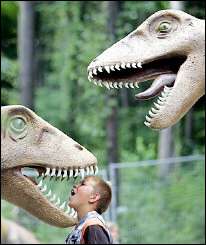
A German youth sticks his head in the mouth of a dinosaur figure

Scientists reportedly have found the fossil of a previously unknown species of dinosaur that lived more than 100 million years ago in what is now Mongolia.

The dinosaur, which had air sacs in some of its bones to help support a 24-foot-long neck, belonged to a group of plant-munching giants called sauropods -- the largest animals ever to have walked the Earth, National Geographic News reported.

Paleontologists Daniel Ksepka and Mark Norell of the American Museum of Natural History in New York discovered the fossil in Mongolia's Gobi desert in 2002, including a neck vertebra that measures nearly 2 feet in length.

The newly described species is named Erketu ellisoni. Erketu, the god of might, was one of 99 deities from pre-Buddhist Mongolian tradition, NGN reported.

The paleontologists' analysis of their find was detailed in last week's issue of the museum's journal, Novitates.

Copyright 2006 by United Press International

Explore further: US: NYU researchers took bribes from Chinese group

add to favorites email to friend print save as pdf

Related Stories

Four dinosaur species identified

May 08, 2013

Just when dinosaur researchers thought they had a thorough knowledge of ankylosaurs, a family of squat, armour plated, plant eaters, along comes University of Alberta graduate student, Victoria Arbour.

Scientists reveal new species of dog-sized dinosaur

May 07, 2013

Scientists have named a new species of bone-headed dinosaur (pachycephalosaur) from Alberta, Canada. Acrotholus audeti (Ack-RHO-tho-LUS) was identified from both recently discovered and historically collec ...

Recommended for you

US: NYU researchers took bribes from Chinese group

10 hours ago

Three New York University researchers from China divulged results from a U.S.-funded study to Chinese competitors in exchange for tuition, rent and other expenses, federal prosecutors said Monday.

Relaxed tourists share more

18 hours ago

Tourists set on relaxing and socialising when they reach their holiday destination tend to do little advance research on the internet before making their trip, but are more likely to share travel information and photos on ...

Tiny ancient bandicoot shines light on future

20 hours ago

(Phys.org) —A 20 million-year-old fossil skull identified as a 'pocket-sized' ancestor of the bandicoot will give insights into the future of Australia's modern endangered animals.

User comments : 0

More news stories

Tiny ancient bandicoot shines light on future

(Phys.org) —A 20 million-year-old fossil skull identified as a 'pocket-sized' ancestor of the bandicoot will give insights into the future of Australia's modern endangered animals.

Child maltreatment increases risk of adult obesity

Children who have suffered maltreatment are 36% more likely to be obese in adulthood compared to non-maltreated children, according to a new study by King's College London. The authors estimate that the prevention or effective ...

New immune system discovered

(Medical Xpress)—A research team, led by Jeremy Barr, a biology post-doctoral fellow, unveils a new immune system that protects humans and animals from infection.

Lab sets a new record for creating heralded photons

(Phys.org) —Entanglement, by general consensus of physicists, is the weirdest part of quantum science. To say that two particles, A and B, are entangled means that they are actually two parts of an inseparable ...