The Universe: It's not as violent as we think
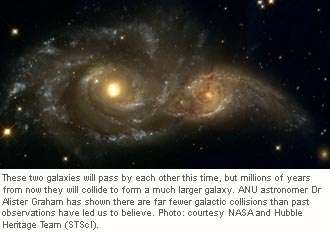
The Universe has experienced far fewer collisions among galaxies than previously thought, according to a new analysis of Hubble Space Telescope data by an ANU researcher. Astronomer Dr Alister Graham, from the Research School of Astronomy and Astrophysics, analysed a sample of galaxies located 100 million light years away — and discovered that the number of violent encounters between large galaxies is around one-tenth of the number earlier studies had suggested. Although theoretical models predict that fewer collisions were involved in the evolution of the universe, Dr Graham’s observations are the first that confirm these theories.
“The new result is in perfect agreement with popular models of hierarchical structure formation in our universe,” Dr Graham said. “Galactically speaking, things appear to be a little safer out there.”
For years, astronomers have known the collision and merger of galaxies resulted in the formation of larger galaxies. The biggest of these galaxies appear largely devoid of stars at their cores, a phenomenon believed to result from the damage caused by the ‘supermassive’ black holes from the smaller galaxies as they merge near the centre of the new galaxy.
However, rather than requiring multiple mergers to clear away the stars from the heart of a galaxy, Dr Graham has shown just one collision between two galaxies is sufficient.
Using images from Hubble's Wide Field Planetary Camera 2, Dr Graham was able to examine galaxies 100 million light years away, whose cores had not been depleted of stars, providing an important insight into star distributions before any major collisions occurred. By considering the overall galaxy structure, he was able to more accurately measure the sizes of the depleted cores in the galaxies.
The result: the mass of the deficit of stars at the galaxies centres equalled rather than exceeded the mass of the black hole.
“If there had been 10 mergers, we would have found a star deficit 10 times the mass of the central black hole. Many galaxies have large central black holes but no depleted cores. It is therefore not the case that every black hole is formed by gobbling up its surrounding stars. Instead, we’re observing the demolished cores of galaxies after the union of two massive cosmic wrecking balls.”
Although small satellite galaxies have been captured by our galaxy, the Milky Way, it has not experienced a recent major merger. If it had, the plane of its disk, visible as a faint wide ribbon in the night sky, would have been scattered and dispersed across the heavens. Such a fate is expected in about three billion years when the Milky Way collides with a neighbouring spiral galaxy, Andromeda.
The research was conducted during Dr Graham's tenure at the University of Florida and was funded by NASA via a grant from the Space Telescope Science Institute in Baltimore. Dr Graham’s research will appear in the September 20 edition of Astrophysical Journal Letters.
Source: The Australian National University
-
From lemons to lemonade: Reaction uses carbon dioxide to make carbon-based semiconductor,
32 comments
-
Thioridazine kills cancer stem cells in human while avoiding toxic side-effects of conventional cancer treatments,
3 comments
-
SpaceX private rocket blasts off for space station (Update),
42 comments
-
Climate scientists say they have solved riddle of rising sea,
31 comments
-
SpaceX capsule has 'new car' smell, astronauts say (Update),
4 comments
More news stories
Land and sea species differ in climate change response: study
(Phys.org) -- Marine and terrestrial species will likely differ in their responses to climate warming, new research by Simon Fraser University and Australia’s University of Tasmania has found.
7 hours ago |
3.8 / 5 (4) |
5
|
Yale study concludes public apathy over climate change unrelated to science literacy
Are members of the public divided about climate change because they don't understand the science behind it? If Americans knew more basic science and were more proficient in technical reasoning, would public consensus match ...
9 hours ago |
4.8 / 5 (5) |
20
|
10 million years needed to recover from mass extinction
It took some 10 million years for Earth to recover from the greatest mass extinction of all time, latest research has revealed.
Space & Earth / Earth Sciences
9 hours ago |
4 / 5 (4) |
1
|
Sophisticated simulations predict future warming
The chances of our planet being hit by a global warming of 3 degrees Celsius by 2050 is as likely as it being hit by an increase of 1.4 degrees, new research shows. Presented in the journal Nature Geoscience, the British study ...
Space & Earth / Earth Sciences
May 22, 2012 |
3.8 / 5 (11) |
51
Aliens don't want to eat us, says former SETI director
Alien life probably isnt interested in having us for dinner, enslaving us or laying eggs in our bellies, according to a recent statement by former SETI director Jill Tarter.
Space & Earth / Space Exploration
May 25, 2012 |
4.4 / 5 (15) |
41
Stunning image of smallest possible five-ringed structure
Scientists have created and imaged the smallest possible five-ringed structure about 100,000 times thinner than a human hair and you'll probably recognise its shape.
'Unzipped' carbon nanotubes could help energize fuel cells, batteries
Multi-walled carbon nanotubes riddled with defects and impurities on the outside could replace some of the expensive platinum catalysts used in fuel cells and metal-air batteries, according to scientists at ...
Change in developmental timing was crucial in the evolutionary shift from dinosaurs to birds: study
At first glance, it's hard to see how a common house sparrow and a Tyrannosaurus Rex might have anything in common. After all, one is a bird that weighs less than an ounce, and the other is a dinosaur that ...
Computer model used to pinpoint prime materials for efficient carbon capture
When power plants begin capturing their carbon emissions to reduce greenhouse gases and to most in the electric power industry, it's a question of when, not if it will be an expensive undertaking.
T cells 'hunt' parasites like animal predators seek prey, study shows
By pairing an intimate knowledge of immune-system function with a deep understanding of statistical physics, a cross-disciplinary team at the University of Pennsylvania has arrived at a surprising finding: T cells use a movement ...
Scientists develop ultra-sensitive test that detects diseases in their earliest stages
Scientists have developed an ultra-sensitive test that should enable them to detect signs of a disease in its earliest stages, in research published today in the journal Nature Materials.