Larry's cool change good for reef
Mar 22, 2006
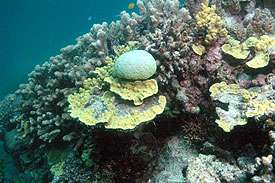
Coral reef at Heron Island. Photo: Ove Hoegh-Guldberg

Cyclone Larry has been a nightmare on land but underwater, it may have helped save the Great Barrier Reef from disaster. University of Queensland coral reef expert Professor Ove Hoegh-Guldberg said Larry's wind had cooled ocean temperatures that had skyrocketed this summer and threatened to bleach the corals of the Reef.

“Cyclones mix the water column and cool things down, so as we move into winter and with cyclones like this, the real threat of a major bleaching event has passed,” Director of UQ's Centre for Marine Studies Professor Hoegh-Guldberg said.

Professor Hoegh-Guldberg, who first identified widespread coral bleaching at the southern end of the Reef around the Keppel Islands in January, had feared more than 60 percent of the Reef might bleach as it did in 2002.

So far, he said about half of the coral in 1000 square kilometres of inshore reef from Mackay to Hervey Bay had bleached.

Prolonged coral bleaching can lead to coral death and the loss of coral reef habitats for a wide variety of marine life. This is a worry for scientists and reef enthusiasts because the Great Barrier Reef may house more than a million species.

Professor Hoegh-Guldberg said Cyclone Larry had left its mark on the land but the cyclone had moved too quickly across the reef to cause major damage.

“It was so intense and moved so quickly that it crossed the Great Barrier Reef in a matter of hours.

“In a way it's fortunate that it didn't linger and for that reason it's unlikely that it had major impacts on reef structure but we still need to do underwater surveys.”

He said the latest bleaching was the worst reef event since 2002 when the Reef around Townsville and Cairns was bleached. This time, bleaching only caused distress on the southern Great Barrier Reef.

UQ researchers are teaming up with NASA scientists to find out why different parts of the Reef have bleached in different events.

“It's prompting some very interesting questions about why it was so low on the Reef this year when it was so central in 2002.

“We're starting to do some projects here at UQ that are understanding how oceanography interacts with the geography of the bleaching.”

Source: University of Queensland

Explore further: New atmospheric modeling paradigm breaks previously accepted notions

add to favorites email to friend print save as pdf

Related Stories

Scientists call for large ocean wilderness parks

Apr 15, 2013

Leading international marine scientists have called for the protection of more, large marine wilderness areas in a bid to shield the world's dwindling stocks of fish from destruction.

Remote reefs can be tougher than they look

Apr 04, 2013

(Phys.org) —Isolated coral reefs can recover from catastrophic damage as effectively as those with nearby undisturbed neighbours, a long-term study by marine biologists from the Australian Institute of Marine ...

Recommended for you

Hubble reveals the ring nebula's true shape

8 hours ago

(Phys.org) —The Ring Nebula's distinctive shape makes it a popular illustration for astronomy books. But new observations by NASA's Hubble Space Telescope of the glowing gas shroud around an old, dying, ...

NASA head views progress on asteroid lasso mission

9 hours ago

Surrounded by engineers, NASA chief Charles Bolden inspected a prototype spacecraft engine that could power an audacious mission to lasso an asteroid and tow it closer to Earth for astronauts to explore.

Ecuador satellite collides with Russian space junk

9 hours ago

A small Ecuadoran satellite collided in orbit with the remains of a Russian rocket, but it is too soon to know how much damage it might have sustained, Quito's space agency said Thursday.

User comments : 0

More news stories

A hidden population of exotic neutron stars

(Phys.org) —Magnetars – the dense remains of dead stars that erupt sporadically with bursts of high-energy radiation - are some of the most extreme objects known in the Universe. A major campaign using ...

Hubble reveals the ring nebula's true shape

(Phys.org) —The Ring Nebula's distinctive shape makes it a popular illustration for astronomy books. But new observations by NASA's Hubble Space Telescope of the glowing gas shroud around an old, dying, ...

NASA head views progress on asteroid lasso mission

Surrounded by engineers, NASA chief Charles Bolden inspected a prototype spacecraft engine that could power an audacious mission to lasso an asteroid and tow it closer to Earth for astronauts to explore.

Controlling mood through the motions of mitochondria

(Medical Xpress)—Regulating the distribution of power in neurons is done by a system that makes the national electric grid look simple by comparison. Each neuron has several thousand mitochondria confined ...