Edible 'antifreeze' prevents unwanted ice crystals in ice cream and frozen foods
Jan 14, 2008
Edible 'antifreeze' prevents unwanted ice crystals in ice cream and frozen foods
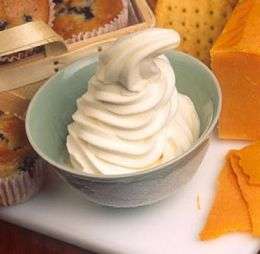
Researchers have developed an edible "antifreeze" that shows promise for preventing the formation of ice crystals in ice cream. Credit: Courtesy of USDA-ARS, Keith Weller

A scientist in Wisconsin reports development of an edible and tasteless “antifreeze” that prevents the formation of ice crystals that can spoil the smooth, silky texture of ice cream and interfere with the palatability of other frozen foods. The study is scheduled for the Jan. 9 issue of ACS’ Journal of Agricultural and Food Chemistry, a bi-weekly publication.

In the new report, Srinivasan Damodaran explains that preventing the formation of large ice crystals is a major challenge for frozen food manufacturers and consumers who store packages in home freezers. Although several different substances have been added to frozen foods to prevent ice crystal growth, none is really effective, the researcher says.

Damodaran’s solution is gelatin hydrolysate, a protein known to act as a natural antifreeze. In a controlled study using batches of ice cream prepared with and without the non-toxic compound, ice cream containing the antifreeze developed significantly smaller and fewer ice crystals than batches prepared without the compound, the researcher says.

Source: ACS

Explore further: Detecting mirror molecules: New technique reliably tells left-handed from right-handed variant of a compound

add to favorites email to friend print save as pdf

Related Stories

Why don't beetles freeze in the winter?

May 14, 2013

For 37 years, Queen's University Biochemistry professor Peter Davies has been unraveling the mystery of why some organisms including insects and fish don't freeze in the winter. His research into insect antifreeze protein ...

Weather forecasts on Mars

May 08, 2013

(Phys.org) —In the north of the red planet snowfalls occur with great regularity. Expeditions of Mars rovers into this region could therefore be easily planned.

NASA Goddard lab works at extreme edge of cosmic ice

Mar 04, 2013

(Phys.org) —Behind locked doors, in a lab built like a bomb shelter, Perry Gerakines makes something ordinary yet truly alien: ice. This isn't the ice of snowflakes or ice cubes. No, this ice needs such ...

Recommended for you

Cradle turns smartphone into handheld biosensor

6 hours ago

(Phys.org) —Researchers and physicians in the field could soon run on-the-spot tests for environmental toxins, medical diagnostics, food safety and more with their smartphones.

Unspooling DNA from nucleosomal disks

9 hours ago

The tight wrapping of genomic DNA around nucleosomes in the cell nucleus makes it unavailable for gene expression. A team of Ludwig-Maximilians-Universitaet (LMU) in Munich now describes a mechanism that allows chromosomal ...

User comments : 0

More news stories

Chemists find new compounds to curb staph infection

(Phys.org) —In an age when microbial pathogens are growing increasingly resistant to the conventional antibiotics used to tamp down infection, a team of Wisconsin scientists has synthesized a potent new ...

Controlling mood through the motions of mitochondria

(Medical Xpress)—Regulating the distribution of power in neurons is done by a system that makes the national electric grid look simple by comparison. Each neuron has several thousand mitochondria confined ...

Google Drive sports new view and scan enhancements

(Phys.org) —Google Drive has a new look and functions. The makeover in Google Drive features scanning and interface enhancements that put the user into "card" mode. The enhancements make it easy for the ...