Scientists find cultural differences among chimpanzee colonies
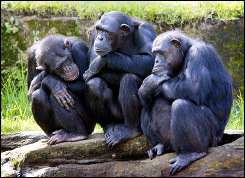
Socially-learned cultural behaviour thought to be unique to humans is also found among chimpanzees colonies, scientists at the University of Liverpool have found.
Historically, scientists believed that behavioural differences between colonies of chimpanzees were due to variations in genetics. A team at Liverpool, however, has now discovered that variations in behaviour are down to chimpanzees migrating to other colonies, proving that they build their ‘cultures’ in a similar way to humans.
Primatologist, Dr Stephen Lycett, explains: “We knew there were behavioural differences between chimpanzee colonies, but nobody really knew why. It was assumed that young chimpanzees developed certain behavioural characteristics from the genes passed down from their parents, but there was no evidence to clearly support this. It was also thought that because behaviour was dictated by biology, chimpanzees did not have a ‘culture’ in the same way that humans do.”
By looking at how chimpanzees prepare their food, the research team discovered that one colony used stone tools to crack nuts, whereas another colony used wooden tools as well as stone. They found these methods of preparing food have spread 4000km from East to West Africa over the more than 100,000 years. The team also found this true of other techniques, such as grooming. The research suggests that behavioural variety is due to how chimpanzees socialise rather than genetics as previously thought.
To investigate the theory further researchers built an evolutionary tree of chimpanzee behaviour in East and West Africa as well as a genetic family tree. They had expected to find that those with similar genetic patterns also shared behavioural similarities. Instead, they found that some chimpanzees shared behavioural similarities with those that were genetically different from them.
Dr Lycett, added: “This explains why some colonies, for example, use similar methods for finding food, adopting certain behaviour and adapting different methods to suit their own environment. In this sense we can see for the first time that culture exists in our closest relatives.”
The research is published in Proceedings of the National Academy of Sciences USA.
Source: University of Liverpool


