Synchrotron x-ray experiments in the world's strongest magnetic field
March 17, 2006

Synchrotron x-ray experiments in the world's strongest magnetic field

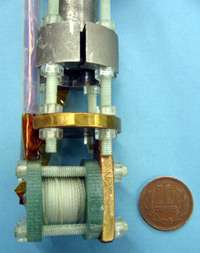
Figure 1. A miniature pulsed magnet attached to the sample-rod of a helium cryostat. The magnet is cooled down to helium temperature together with a sample. This magnet is a solenoid type coil wound by AgCu wire; the outer part is reinforced by grass fibers. A Japanese 10 yen coin is on the right hand side of the magnet as a scale. (Courtesy: SPring-8)

A combination of high magnetic fields and "quantum beam" such as synchrotron x-rays or neutrons is one of most powerful experimental means to examine the magnetic and the electronic properties of strongly correlated electron systems and of functional materials for spintronics applications.

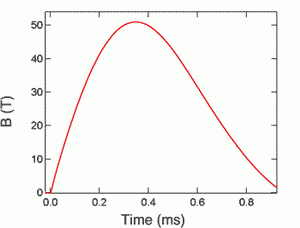
Recently, a team of Japanese researchers have succeeded in performing the high magnetic field synchrotron x-ray experiments up to 51 Tesla at the BL22XU beamline of SPring-8 (Fig 2).
Synchrotron x-ray experiments in the world's strongest magnetic field

Figure 2. A wave form of pulsed magnetic field generated by the mini-magnet. The high field up to 51 T is generated and the energy used is around 1.4 kJ. (Courtesy: SPring-8)

It is the world's strongest magnetic field used for the quantum beam experiment. As the first series of experiments, the field-induced valance transitions in rare-earth inter-metallic compounds have been studied by means of x-ray absorption spectra and x-ray diffraction.

The key of this achievement is the use of the miniature pulsed-magnet (Fig 1). The volume and the energy of the present magnet are as small as 1 % of those of conventional pulsed magnet.

Moreover, the miniature pulsed-magnet is readily installed into the standard cryogenic system of a conventional diffractometer. This feature enables us to perform such high field experiments rather easily. The present achievements will open a variety of new applications in x-ray scattering and x-ray spectroscopy in extremely strong magnetic fields.

This work was done as the collaboration work among Okayama University, Japan Atomic Energy Agency and Tohoku University, and was supported by Grant-in-Aid for Scientific Research on priority Areas “High Field Spin Science in 100 T” from the Ministry of Education, Culture, Sports, Science and Technology (MEXT). The part of the results of this work was published in Journal of the Physical Society of Japan.

Citation:"High Field X-ray Diffraction Study on a Magnetic-Field-Induced Valence Transition in YbInCu4", Y. H. Matsuda, et. at., Journal of the Physical Society of Japan, Vol. 75 No. 2, February, 2006

Source: SPring-8

3.4 /5 (7 votes)  

Rank 3.4 /5 (7 votes)
Related Stories
Tags

Relevant PhysicsForums posts

More news stories

Is a classical electrodynamics law incompatible with special relativity?

(Phys.org) -- The laws of classical electromagnetism that were developed in the 19th century are the same laws that scientists use today. They include Maxwell’s four equations along with the Lorentz la ...

Physics / General Physics

created May 24, 2012 | popularity 4.7 / 5 (18) | comments 43 | with audio podcast feature

Landmark calculation clears the way to answering how matter is formed

(Phys.org) -- An international collaboration of scientists, including Thomas Blum, associate professor of physics, is reporting in landmark detail the decay process of a subatomic particle called a kaon – ...

Physics / General Physics

created May 25, 2012 | popularity 4.3 / 5 (22) | comments 53 | with audio podcast

Lying in wait for WIMPs: Researchers seek to dramatically increase sensitivity of Large Underground Xenon detector

Although it's invisible, dark matter accounts for at least 80 percent of the matter in the universe. No one knows what it is, but most scientists would bet on weakly interacting massive particles, or WIMPs.

Physics / General Physics

created May 23, 2012 | popularity 4 / 5 (7) | comments 18 | with audio podcast

Hawaii lab turns laser-powered bubbles into microrobots

(Phys.org) -- A team of scientists from the University of Hawaii are working on microrobots created from bubbles of air in a saline solution. The bubbles take on their title of “robots” as a laser ...

Physics / General Physics

created May 23, 2012 | popularity 5 / 5 (4) | comments 2 | with audio podcast weblog

Sound increases the efficiency of boiling

Scientists at the Georgia Institute of Technology achieved a 17-percent increase in boiling efficiency by using an acoustic field to enhance heat transfer. The acoustic field does this by efficiently removing vapor bubbles ...

Physics / Soft Matter

created May 24, 2012 | popularity 5 / 5 (2) | comments 2


Stunning image of smallest possible five-ringed structure

Scientists have created and imaged the smallest possible five-ringed structure – about 100,000 times thinner than a human hair – and you'll probably recognise its shape.

'Unzipped' carbon nanotubes could help energize fuel cells, batteries

Multi-walled carbon nanotubes riddled with defects and impurities on the outside could replace some of the expensive platinum catalysts used in fuel cells and metal-air batteries, according to scientists at ...

Change in developmental timing was crucial in the evolutionary shift from dinosaurs to birds: study

At first glance, it's hard to see how a common house sparrow and a Tyrannosaurus Rex might have anything in common. After all, one is a bird that weighs less than an ounce, and the other is a dinosaur that ...

Computer model used to pinpoint prime materials for efficient carbon capture

When power plants begin capturing their carbon emissions to reduce greenhouse gases – and to most in the electric power industry, it's a question of when, not if – it will be an expensive undertaking.

T cells 'hunt' parasites like animal predators seek prey, study shows

By pairing an intimate knowledge of immune-system function with a deep understanding of statistical physics, a cross-disciplinary team at the University of Pennsylvania has arrived at a surprising finding: T cells use a movement ...

Land and sea species differ in climate change response: study

(Phys.org) -- Marine and terrestrial species will likely differ in their responses to climate warming, new research by Simon Fraser University and Australia’s University of Tasmania has found.