Biochip mimics the body to reveal toxicity of industrial compounds
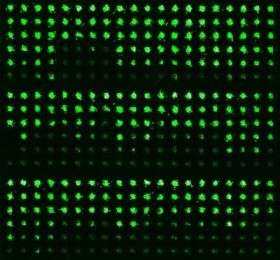
A new biochip technology could eliminate animal testing in the chemicals and cosmetics industries, and drastically curtail its use in the development of new pharmaceuticals, according to new findings from a team of researchers at Rensselaer Polytechnic Institute, the University of California at Berkeley, and Solidus Biosciences Inc.
The team's most recent discovery will be featured in the online Early Edition of the Proceedings of the National Academy of Sciences (PNAS) on Dec. 17.
The researchers have developed two biochips, the DataChip and the MetaChip, that combine to reveal the potential toxicity of chemicals and drug candidates on various organs in the human body, and whether those compounds will become toxic when metabolized in the body, all in one experiment without the use of live animals.
Traditional toxicity testing involves the use of animals to predict whether a chemical or drug candidate is toxic. However, with the large number of compounds being generated in the pharmaceutical industry, and new legislation stipulating that chemicals undergo toxicity analysis, there is a rapidly emerging need for high-throughput toxicity testing.
"We looked at the issues facing companies and realized that we needed to develop something that was low-cost, high-throughput, easily automatable, and did not involve animals," said co-lead author Jonathan S. Dordick, the Howard P. Isermann '42 Professor of Chemical and Biological Engineering at Rensselaer and co-founder of Solidus Biosciences Inc., the company that is working to commercialize the chips. "We developed the MetaChip and DataChip to deal with the two most important issues that need to be assessed when examining the toxicity of a compound -- the effect on different cells in our body and how toxicity is altered when the compound is metabolized in our bodies."
When the biochips are used together the result is a promising and affordable alternative to animal-based toxicology screening and a direct route to developing safe, effective drugs, according to Dordick, who is also a member of the Rensselaer Center for Biotechnology and Interdisciplinary Studies.
Currently, detailed toxicity screening does not come into the drug discovery process until later in the development, when significant time and money have been invested in a compound by a company. And animal testing does not always provide information that translates to predicting the toxicity of a compound or its metabolites in a human, Dordick said.
The collaborative team sees the combined chips as an efficient, more accurate way to test drug compounds for toxicity earlier in the discovery process. But, co-lead author and Solidus Biosciences co-founder Douglas S. Clark, professor of chemical engineering at the University of California at Berkeley, views pharmaceutical companies as only one potential user, and not necessarily the first.
"The initial market will not necessarily be pharmaceuticals," Clark said. He further explains that the initial market will likely be chemical and cosmetic companies that are being pushed to eliminate animal testing or cannot afford such testing. In fact, by 2009 cosmetics companies in Europe will be restricted from using animals in testing for chemical toxicity. "Obviously cosmetics need to be safe, and ensuring the safety of new compounds without testing them on animals presents a new challenge to the industry, especially as the number of compounds increases. These chips can meet this challenge by providing comprehensive toxicity data very quickly and cheaply."
The team's most recent achievement outlined in PNAS is the DataChip, a biochip comprising up to 1,080 three-dimensional human cell cultures. The three-dimensional structure is more closely in line with how the cells would be arranged in organs of the human body. The DataChip can provide companies or academic labs with an extremely fast screen of potential toxicity of chemicals and drug candidates on different types of human cells.
In an earlier paper published in a Jan. 25, 2005, edition of PNAS, the team introduced the MetaChip. The biochip mimics the metabolic reactions of the human liver, where chemicals and drugs are processed in the body. Depending on the compound, a seemingly benign chemical like acetaminophen can become highly toxic when metabolized by the liver. Because of differences in the type and amount of their drug-metabolizing enzymes, most of which are in the liver, individuals can metabolize a drug or other chemical compound differently. What is harmless to one person may be toxic to another. By arranging the ratio of enzymes on the MetaChip, scientists could develop a personalized chip to determine how toxic a drug might be to different people.
"We are still a ways off from personalized medicine, but the MetaChip offers that future possibility," Dordick said. When coupled with the new DataChip, the two chips could someday be used to determine the levels and combinations of drugs that are safe and effective for each individual patient, Clark explains.
Source: Rensselaer Polytechnic Institute


