Sperm's immune-protection properties could provide link to how cancers spread
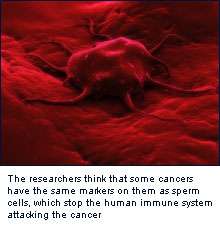
Sugar-based markers on human sperm cells which may prevent them from being attacked by the female immune system could provide a vital clue to how some cancers spread in the human body, according to new research published on 14 December 2007.
The new research, currently available online in the Journal of Biological Chemistry, analysed these markers which are believed to tell the female immune system that the sperm are not dangerous pathogens, and therefore should not be attacked by the woman's white blood cells during the reproductive process.
The study, led by Imperial College London and the University of Missouri, suggests that these sugar markers can be universally recognised by all human immune systems, regardless of the individual.
Professor Anne Dell from Imperial College London's Department of Life Sciences, one of the study's lead authors, said: "Normal human cells carry chemical markers made of proteins which tell the immune system not to attack them. In the case of organ transplants, for example, doctors try to match these markers in both the donor and the recipient to prevent rejection. However, in the case of sperm cells, their sugar-based markers are different: they are recognised by everyone's immune system, meaning that no immune response is triggered during reproduction between any two people."
This kind of marker is also found on some types of cancer cells, some bacterial cells, some parasitic worms and HIV infected white blood cells. The scientists believe that these markers allow such dangerous cells and pathogens to evade destruction by the human immune system, leading to serious – sometimes fatal - illness.
Professor Dell explains that understanding how this basic biology works on sperm cells may lead to greater knowledge of how some serious diseases and infections manage to win the battle with the human immune system. She says:
"If aggressive cancers and pathogens are using the same system of universally-recognisable markers to trick the immune system into thinking they're harmless, we need to work out exactly how this interaction works. This is where we're planning to take this research next. Understanding how these markers work at a basic biological and chemical level could lead to new ways to treat or prevent cancers and other diseases in the future."
Citation: 'Expression of Bisecting Type and Lewisx/Lewisy Terminated N-Glycans on Human Sperm', The Journal of Biological Chemistry, 14 December 2007.
Source: Imperial College London
-
From lemons to lemonade: Reaction uses carbon dioxide to make carbon-based semiconductor,
32 comments
-
Thioridazine kills cancer stem cells in human while avoiding toxic side-effects of conventional cancer treatments,
3 comments
-
SpaceX private rocket blasts off for space station (Update),
42 comments
-
Climate scientists say they have solved riddle of rising sea,
31 comments
-
SpaceX capsule has 'new car' smell, astronauts say (Update),
4 comments
More news stories
Computer model used to pinpoint prime materials for efficient carbon capture
When power plants begin capturing their carbon emissions to reduce greenhouse gases and to most in the electric power industry, it's a question of when, not if it will be an expensive undertaking.
8 hours ago |
not rated yet |
0
|
Scientists develop ultra-sensitive test that detects diseases in their earliest stages
Scientists have developed an ultra-sensitive test that should enable them to detect signs of a disease in its earliest stages, in research published today in the journal Nature Materials.
Chemistry / Analytical Chemistry
8 hours ago |
not rated yet |
0
|
New CO2-removing catalyst can take the heat
(Phys.org) -- The current method of removing the greenhouse gas carbon dioxide (CO2) from the flues of coal-fired power plants uses so much energy that no one bothers to use it. So says Roger Aines, principal ...
May 24, 2012 |
5 / 5 (9) |
11
|
High-speed method to aid search for solar energy storage catalysts
Eons ago, nature solved the problem of converting solar energy to fuels by inventing the process of photosynthesis.
May 25, 2012 |
5 / 5 (3) |
4
|
Researchers demonstrate possible primitive mechanism of chemical info self-replication
(Phys.org) -- When scientists think about the replication of information in chemistry, they usually have in mind something akin to what happens in living organisms when DNA gets copied: a double-stranded molecule ...
May 25, 2012 |
5 / 5 (4) |
2
|
Stunning image of smallest possible five-ringed structure
Scientists have created and imaged the smallest possible five-ringed structure about 100,000 times thinner than a human hair and you'll probably recognise its shape.
'Unzipped' carbon nanotubes could help energize fuel cells, batteries
Multi-walled carbon nanotubes riddled with defects and impurities on the outside could replace some of the expensive platinum catalysts used in fuel cells and metal-air batteries, according to scientists at ...
Change in developmental timing was crucial in the evolutionary shift from dinosaurs to birds: study
At first glance, it's hard to see how a common house sparrow and a Tyrannosaurus Rex might have anything in common. After all, one is a bird that weighs less than an ounce, and the other is a dinosaur that ...
T cells 'hunt' parasites like animal predators seek prey, study shows
By pairing an intimate knowledge of immune-system function with a deep understanding of statistical physics, a cross-disciplinary team at the University of Pennsylvania has arrived at a surprising finding: T cells use a movement ...
Land and sea species differ in climate change response: study
(Phys.org) -- Marine and terrestrial species will likely differ in their responses to climate warming, new research by Simon Fraser University and Australia’s University of Tasmania has found.
Yale study concludes public apathy over climate change unrelated to science literacy
Are members of the public divided about climate change because they don't understand the science behind it? If Americans knew more basic science and were more proficient in technical reasoning, would public consensus match ...