Building disease-beating wheat
Dec 12, 2007
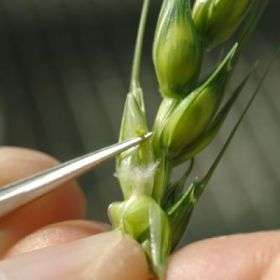
Flowering Wheat Head
The project has the potential to considerably speed up the process of wheat breeding. Credit: Photo by: Carl Davies, CSIRO

Pioneered by CSIRO researchers, in collaboration with the International Maize and Wheat Improvement Center (CIMMYT) and Sydney University, the research illustrates the major genetic improvements possible without genetic modification (GM) technology.

“Wheat breeders often use wild relatives of wheat as sources of novel genes in breeding new disease-resistant wheats,” research team leader Dr Phil Larkin says.

“Unfortunately genes from wild relatives usually come in large blocks of hundreds of genes, and often include undesirable genes. Furthermore, these blocks of genes tend to stay together, even after many generations of breeding.

“The problem can be so difficult to overcome that plant breeders sometimes give up on very valuable genes because they cannot separate them from the problematic genes.”

A paper published this month in the respected international journal Theoretical and Applied Genetics details how the team ‘recombined’ two wild blocks of genes from two different Thinopyrum grass species – a wild relative of wheat – bringing together resistance genes for leaf rust and Barley Yellow Dwarf Virus (BYDV), two of the world’s most damaging wheat diseases. The recombined gene ‘package’ may also carry a resistance gene against a new stem rust strain which is causing concern worldwide.

“The exciting part of the new research is that we have been able to retain the useful genes but leave behind the associated undesirable genes - most notably in this case those for yellow flour colour, an important quality characteristic in wheat,” Dr Larkin says.

By developing new ‘DNA markers’ and by careful testing the team has produced a number of the disease resistance ‘packages’ for wheat breeders, making it faster and easier to include these important disease resistance traits in future wheat varieties.

Source: CSIRO Australia

Explore further: Front-row seats to climate change

add to favorites email to friend print save as pdf

Related Stories

Gene to reduce wheat yield losses

Feb 19, 2009

A new gene that provides resistance to a fungal disease responsible for millions of hectares of lost wheat yield has been discovered by scientists from the US and Israel.

Bread wheat's large and complex genome is revealed

Nov 28, 2012

Bread wheat (Triticum aestivum) is one of the "big three" globally important crops, accounting for 20% of the calories consumed by people. Fully 35% of the world's 7 billion people depend on this staple crop f ...

Recommended for you

Front-row seats to climate change

May 17, 2013

By day, insects provide the white noise of the South, but the night belongs to the amphibians. In a typical year, the Southern air hangs heavy from the humidity and the sounds of wildlife.

Climate change may have little impact on tropical lizards

May 17, 2013

A new Dartmouth College study finds human-caused climate change may have little impact on many species of tropical lizards, contradicting a host of recent studies that predict their widespread extinction in a rapidly warming ...

Wetlands: value to locals matters most

May 17, 2013

A new way of valuing ecosystem services, incorporating the local perspective, is the driving force behind a project assessing aquatic ecosystems in highland areas of Asia

User comments : 0

More news stories

Morocco to harness the wind in energy hunt

Morocco is ploughing ahead with a programme to boost wind energy production, particularly in the southern Tarfaya region, where Africa's largest wind farm is set to open in 2014.

Galaxy's Ring of Fire

Johnny Cash may have preferred this galaxy's burning ring of fire to the one he sang about falling into in his popular song. The "starburst ring" seen at center in red and yellow hues is not the product of ...