New Hubble images show similar colors for Pluto's moons
Mar 10, 2006
New Hubble images show similar colors for Pluto's moons
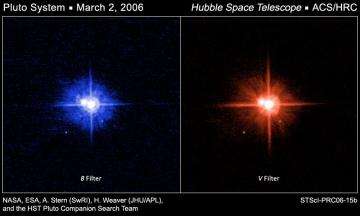
These NASA Hubble Space Telescope images of Pluto were taken on March 2, 2006. Credit: NASA, ESA, A. Stern (Southwest Research Institute), H. Weaver (Johns Hopkins University/Applied Physics Lab), and the HST Pluto Companion Search Team.

Using new Hubble Space Telescope observations, a research team led by Dr. Hal Weaver of the Johns Hopkins University Applied Physics Laboratory and Dr. Alan Stern of the Southwest Research Institute has found that Pluto's three moons are essentially the same color – boosting the theory that the Pluto system formed in a single, giant collision.

Publishing their findings in an International Astronomical Union Circular (No. 8686), the team determined that Pluto's two "new" satellites, discovered in May 2005 and provisionally called S/2005 P 1 and S/2005 P 2, have identical colors to one another and are essentially the same, neutral color as Charon, Pluto's large moon discovered in 1978.

All three satellites have surfaces that reflect sunlight with equal efficiency at all wavelengths, which means they have the same color as the Sun or Earth's moon. In contrast, Pluto has more of a reddish hue.

The new observations were obtained March 2 with the high-resolution channel of the Hubble's Advanced Camera for Surveys. The team determined the bodies' colors by comparing the brightness of Pluto and each moon in images taken through a blue filter with those taken through a green/red filter.

"The high quality of the new data leaves little doubt that the hemispheres of P1 and P2 that we observed have essentially identical, neutral colors," says Weaver.

The new results further strengthen the hypothesis that Pluto and its satellites formed after a collision between two Pluto-sized objects nearly 4.6 billion years ago. "Everything now makes even more sense," says Stern. "If all three satellites presumably formed from the same material lofted into orbit around Pluto from a giant impact, you might well expect the surfaces of all three satellites to have similar colors."

The researchers hope to make additional Hubble color observations, in several more filters, to see if the similarity among the satellites persists to longer (redder) wavelengths. They have proposed to obtain compositional information on the new satellites by observing them at near-infrared wavelengths, where various ice and mineral absorptions are located. The researchers also hope to better refine the orbits of P1 and P2 and measure the moons' shapes and rotational periods.

The Hubble observations were made in support of NASA's New Horizons mission to Pluto and the Kuiper Belt. New Horizons launched on Jan. 19, 2006, and will fly through the Pluto system in July 2015, providing the first close-up look at the ninth planet and its moons. Stern leads the mission and science team as principal investigator; Weaver serves as the mission's project scientist. The Johns Hopkins University Applied Physics Laboratory, Laurel, Md., manages the mission for NASA's Science Mission Directorate and operates the New Horizons spacecraft.

Source: Johns Hopkins University

Explore further: Bold action, big money needed to curb Asia floods

add to favorites email to friend print save as pdf

Related Stories

Mission to mysterious Uranus

Oct 12, 2011

Scientists want to send an orbiter and probe to the ice giant planet Uranus, but do the resources exist to support such an ambitious project?

Jupiter gets its stripe back

Nov 25, 2010

(PhysOrg.com) -- Astronomers using three telescopes atop Mauna Kea in Hawaii have recorded the return of a unique belt on Jupiter that periodically fades from dark brown to white. It's most recent fade-out ...

Fantastic Voyage

Nov 02, 2009

By travelling to the outer solar system, the two Voyager spacecraft allowed us to see amazing details of far-distant planets and moons.

Recommended for you

Unraveling the Napo's mystery

1 hour ago

In the United States, rivers and their floodplains are well-documented and monitored. Ecuador's largest river, however, remains largely mysterious. Research led by Michigan State University is helping the ...

Hong Kong launches plan to tackle waste crisis

1 hour ago

Hong Kong on Monday launched a ten-year plan to reduce waste by 40 percent per person as part of efforts to catch up with other leading Asian cities and avert a looming environmental crisis.

Slow earthquakes: It's all in the rock mechanics

5 hours ago

(Phys.org) —Earthquakes that last minutes rather than seconds are a relatively recent discovery, according to an international team of seismologists. Researchers have been aware of these slow earthquakes, ...

User comments : 0

More news stories

Slow earthquakes: It's all in the rock mechanics

(Phys.org) —Earthquakes that last minutes rather than seconds are a relatively recent discovery, according to an international team of seismologists. Researchers have been aware of these slow earthquakes, ...

Unraveling the Napo's mystery

In the United States, rivers and their floodplains are well-documented and monitored. Ecuador's largest river, however, remains largely mysterious. Research led by Michigan State University is helping the ...

Study shows how bilinguals switch between languages

(Medical Xpress)—Individuals who learn two languages at an early age seem to switch back and forth between separate "sound systems" for each language, according to new research conducted at the University of Arizona.

Non-wetting fabric drains sweat

(Phys.org) —Waterproof fabrics that whisk away sweat could be the latest application of microfluidic technology developed by bioengineers at the University of California, Davis.

SARS-like virus claims new life in Saudi

A Saudi man who had contracted the coronavirus has died, raising the death toll in the kingdom from the SARS-like virus to 16, the health ministry announced on Monday on its Internet website.