New method exploits ancient mechanism to switch genes on and off at will
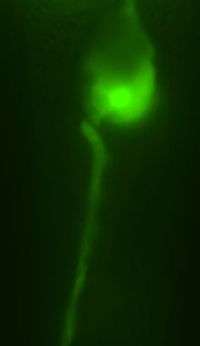
Since our ancestors first harnessed fire, we’ve used heat to cook burgers, forge steel and power rockets. Now, Rockefeller University researchers are using heat for another purpose: turning genes on and off at will.
By exploiting the heat shock response, an ancient mechanism that protects cells from dangerously high temperatures, researchers have developed a new method to introduce foreign genes, called transgenes, into an organism and control when and where these transgenes are expressed. Unlike other techniques, which are labor intensive and inefficient, this new method makes controlling transgene expression as easy as turning the dial on an oven.
During heat shock, a protein called heat shock factor-1 travels from a cell’s cytoplasm to the nucleus, where it binds to a specific sequence of DNA. This interaction initiates the transcription of heat shock protein, a shield that deflects excess heat from cells and protects them from damage. Since these two proteins are expressed at a specific time — when organisms experience heat shock at a specific temperature — scientists had long designed transgenes to be expressed the moment heat shock factor-1 binds to this sequence of DNA. However, while scientists could know when this transgene was expressed, they couldn’t limit its expression in specific cell types and study a particular protein’s effect on them. To do so, they would have to target a single cell with a laser beam until the heat shock response kicked in for the transgene to be expressed. In Caenorhabditis elegans, that’s 34 degrees Celsius.
“If you’re good, each animal would take a couple of minutes,” says Shai Shaham, head of the Laboratory of Developmental Genetics. “And you would need to repeat this many times if you wanted to study a cell’s function and that cell’s role in behavior.”
To bypass this time-intensive work, Shaham and Taulant Bacaj, a graduate student in his lab, used two transgenes — one called the driver, the other the responder — to transform mutant worms that had a deficient heat shock response in every one of their cells into those that had an intact heat shock response in just one cell type. The cell type with the intact response depended on the transgenes being used. In this two-part system, the driver consisted of a portion of DNA that was exclusively expressed in one cell type as well as the gene that encoded heat shock factor-1; the responder consisted of the promoter of a heat shock reponsive gene as well as the gene of interest. Whenever Bacaj turned the dial of the incubator to 34 degrees, the specific cells expressed heat shock factor-1, which induced the expression of the gene of interest.
They first tested this method on glia, cells of the nervous system that are tightly associated with nerve cells and that have been extensively studied in the Shaham lab. They went on to show that the method works in nerve and muscle cells as well, suggesting that it is likely to be generally applicable.
“So, instead of using a laser beam to ablate cells,” says Bacaj, “you could create a responder with a gene that encoded a toxin, one that killed the cells whose function you want to specifically study. Since the heat shock response only occurs in those cells, all you have to do after you create these transgenic animals is turn up the heat to 34 degrees.”
Citation: Genetics 176(4): 2651–2655 (August 2007)
Source: Rockefeller University


