The Unusual Insulating Properties of a Superconductor
Mar 09, 2006
The Unusual Insulating Properties of a Superconductor
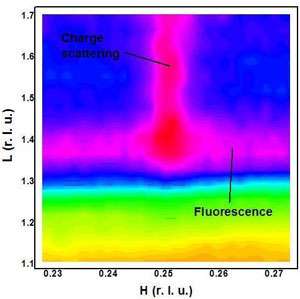
A "reciprocal space map" representation of the stripes in the copper-oxide layers of LBCO. "H" and "L" are measures of how often the ribbon-like stripes "wave." H corresponds to the a direction, and L corresponds to the c direction. Their reciprocals, 1/H and 1/L, are a measure of the stripes' wavelength. The red and pink vertical streak at H = 0.25 indicates that the stripes have a wavelength of four lattice parameters and are stacked along the c direction.

Since their discovery, high-temperature superconductors, a class of remarkable materials that conduct electricity with almost zero resistance, have perplexed scientists. Despite many, many studies, how these materials do what they do is still not well understood. At the National Synchrotron Light Source, scientists have discovered a perhaps odd, yet important clue to the puzzle - that a common high-temperature superconductor actually has distinct insulating properties.

The superconductor is known as "LBCO," named for the elements it contains: lanthanum, barium, copper, and oxygen. LBCO is widely studied and, despite all there is yet to learn, researchers have learned some important things about it. For example, the barium atoms act as the material's sole electric carriers by introducing positively charged vacancies, called "holes," that electrons can jump to. Changing the amount of barium in LBCO thus changes its superconducting behavior. At a certain critical amount of barium - oddly enough - the superconductivity of LBCO disappears.

This disappearance of the superconductivity coincides with the formation of ribbon-like magnetic regions in the material, known as "stripes." Stripes were discovered by Brookhaven Lab physicist John Tranquada in 1995.

"What we were able to show that the holes in LBCO are sandwiched between these magnetic stripes, forming ribbons of electric charge," said Abbamonte. "Significantly, we also found that the magnetic regions have insulating properties. Therefore, the material as a whole is neither a metal nor an insulator, since it retains characteristics of both."

These findings are the result of work performed at NSLS beamline X1B, where the scientists studied LBCO using an x-ray technique called "resonant soft x-ray scattering." They aimed a beam of x-rays at an LBCO sample and used a detector to measure how the x-rays reflected away from the material. They then analyzed these reflections to reveal information about LBCO's electronic structure.

The results of this study are important because they support the theory that stripes are in some way related to superconductivity in high-temperature superconductors.

"Our results seem to support the stripe description of high-temperature superconductors. This is exciting, since it could mean that the scientific community may be very close to truly understanding how these materials perform," said Abbamonte.

The research was published in the December 2005 edition of Nature Physics. The paper's co-authors are Andrivo Rusydi (University of Hamburg), Serban Smadici (BNL/University of Illinois), Genda Gu (BNL), George Sawatzky (University of British Columbia and University of Groningen), and D.L. Feng (Fudan University). The work was supported by the U.S. Department of Energy, the Dutch Science Foundation, and the Netherlands Organization for Fundamental Research on Matter.

Source: National Synchrotron Light Source, by Laura Mgrdichian

Explore further: As chaos celebrates its 50th birthday, biophysicist develops a new method to visualize it

add to favorites email to friend print save as pdf

Related Stories

Disappearing Superconductivity Reappears -- in 2-D

Dec 01, 2008

(PhysOrg.com) -- Scientists studying a material that appeared to lose its ability to carry current with no resistance say new measurements reveal that the material is indeed a superconductor — but only in ...

Paving the Way for Crystal Growth

Mar 07, 2007

In order to study the properties of LBCO superconductors, scientists need to produce large, single crystals of the material - a difficult task that wasn't possible until recently. At the state-of-the-art crystal ...

Recommended for you

A quantum simulator for magnetic materials

3 hours ago

Physicists understand perfectly well why a fridge magnet sticks to certain metallic surfaces. But there are more exotic forms of magnetism whose properties remain unclear, despite decades of intense research. ...

Engineers pioneer flat spray-on optical lens

6 hours ago

A University of British Columbia engineer and a team of U.S. researchers have made a breakthrough utilizing spray-on technology that could revolutionize the way optical lenses are made and used.

Researchers forward quest for quantum computing

8 hours ago

Research teams from UW-Milwaukee and the University of York investigating the properties of ultra-thin films of new materials are helping bring quantum computing one step closer to reality.

How do cold ions slide

8 hours ago

Things not always run smoothly. It may happen, actually, that when an object slides on another, the advancement may occur through a 'stop and go' series in the characteristic manner which scientists call ...

User comments : 0

More news stories

A quantum simulator for magnetic materials

Physicists understand perfectly well why a fridge magnet sticks to certain metallic surfaces. But there are more exotic forms of magnetism whose properties remain unclear, despite decades of intense research. ...

Engineers pioneer flat spray-on optical lens

A University of British Columbia engineer and a team of U.S. researchers have made a breakthrough utilizing spray-on technology that could revolutionize the way optical lenses are made and used.

Researchers forward quest for quantum computing

Research teams from UW-Milwaukee and the University of York investigating the properties of ultra-thin films of new materials are helping bring quantum computing one step closer to reality.

How do cold ions slide

Things not always run smoothly. It may happen, actually, that when an object slides on another, the advancement may occur through a 'stop and go' series in the characteristic manner which scientists call ...

Hubble reveals the ring nebula's true shape

(Phys.org) —The Ring Nebula's distinctive shape makes it a popular illustration for astronomy books. But new observations by NASA's Hubble Space Telescope of the glowing gas shroud around an old, dying, ...

NASA head views progress on asteroid lasso mission

Surrounded by engineers, NASA chief Charles Bolden inspected a prototype spacecraft engine that could power an audacious mission to lasso an asteroid and tow it closer to Earth for astronauts to explore.

Solar Kettle allows for boiling water off the grid

(Phys.org) —A company called Contemporary Energy has unveiled a new device it calls the Solar Kettle. It looks very much like a normal coffee thermos, but has flaps on one side that open to allow for collecting ...