Greenhouse gases from the deep sea
Mar 02, 2006
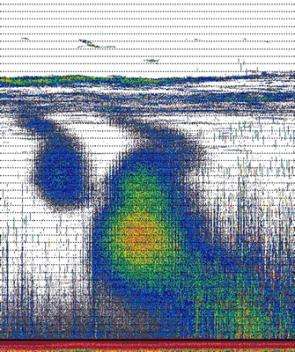
Acoustic image of a methane plume
Acoustic image of a methane plume about 800 metres above Håkon Mosby. Photo: Data from E. Sauter, Alfred-Wegener-Institut.

Methane from the bottom of the sea contributes more to global warming than previously assumed. Scientists of the Alfred Wegener Institute for Polar- and Marine Research investigated a mud volcano located in the deep-sea between Norway und Svalbard.

Greenhouse gases contribute significantly to present changes of the global climate. Carbon dioxide and methane are major greenhouse gases, whereby methane molecules do 20 times more efficiently prevent reverberation of heat into outer space.
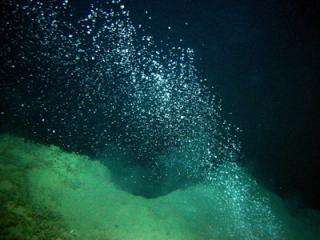
Methane bubbles at Håkon Mosby mud volcano
Methane bubbles at Håkon Mosby mud volcano. Photo: Ifremer.

The sources of methane are mostly known in terrestrial areas; however, oceanic emissions are much less investigated. Our knowledge is in particular poor concerning the amount of methane from oceanic sources that reaches the atmosphere. Hitherto scientists assumed that microorganisms almost immediately destroy methane emitted from the sea floor. Under this assumption methane from the deep-sea would have no impact on the climate.

A German-French-Russian cooperation under the leadership of the Alfred Wegener Institute actually found considerable quantities of deep-sea methane going into the atmosphere. Investigating of the active mud volcano Håkon Mosby between Norway and Svalbard, the scientists discovered a plume of methane bubbles 800 metres above sea floor. By means of optical and acoustical observations researchers found a upward water stream induced by the buoyancy of the bubbles. This upward stream transported methane to the ocean surface even beyond the depth of bubble dissolution. Scientists estimate that the Håkon Mosby mud volcano emits some hundred tons methane per year to the upper water column. "The number of submarine mud volcanoes is estimated to several thousands world-wide", explains Eberhard Sauter, geochemist at the Alfred Wegener Institute. "Their contribution to the global methane budget might be important."

Presently scientists develop an acoustical method to quantify the amount of methane discharged in such plumes. This method is hoped to ease detection and characterization of submarine methane sources. Precise data will optimise modelling of future climate development.

The scientific data are published in “Earth and Planetary Science Letters” and constitute a result of the cooperation between the Alfred Wegener Institute and its French partner institute Ifremer under participation of the Max Planck Institute for Marine Microbiology, Bremen and the Institute for Applied Physics at the Russian Academy of Sciences Nizhny Novgorod.

Source: Alfred Wegener Institute for Polar and Marine Research (AWI)

Explore further: Fragile mega-galaxy is missing link in history of cosmos

add to favorites email to friend print save as pdf

Related Stories

Strange diet for methane consuming microorganisms

Nov 06, 2012

Methane is formed under the absence of oxygen by natural biological and physical processes, e.g. in the sea floor. It is a much more powerful greenhouse gas than carbon dioxide. Thanks to the activity of ...

Methane measurements at low level flight

Jul 26, 2012

A team of scientists from the Alfred Wegener Institute for Polar and Marine Research in the Helmholtz Association (AWI) and the GFZ German Research Centre for Geosciences has just completed an airborne measurement ...

Signs of thawing permafrost revealed from space

Mar 27, 2012

(PhysOrg.com) -- Satellite are seeing changes in land surfaces in high detail at northern latitudes, indicating thawing permafrost. This releases greenhouse gases into parts of the Arctic, exacerbating the ...

How is the Arctic Ocean changing?

Jun 14, 2011

On coming Wednesday, 15 June, the research vessel Polarstern of the German Alfred Wegener Institute for Polar and Marine Research in the Helmholtz Association will set off on its 26th arctic expedition. Over 130 scientists ...

Recommended for you

Forecast for Titan: Wild weather could be ahead

7 hours ago

(Phys.org) —Saturn's moon Titan might be in for some wild weather as it heads into its spring and summer, if two new models are correct. Scientists think that as the seasons change in Titan's northern hemisphere, ...

NASA's Landsat satellite looks for a cloud-free view

7 hours ago

For decades, Landsat satellites have documented the desiccation of the Aral Sea in Central Asia. Once one of the largest seas in the world, it shrunk to a tenth of its original volume after Russia diverted ...

SDO observes mid-level solar flare

8 hours ago

UPDATE 16:30 p.m. EDT: The M7-class flare was also associated with a coronal mass ejection or CME, another solar phenomenon that can send billions of tons of particles into space. While this CME was not Ea ...

User comments : 0

More news stories

Forecast for Titan: Wild weather could be ahead

(Phys.org) —Saturn's moon Titan might be in for some wild weather as it heads into its spring and summer, if two new models are correct. Scientists think that as the seasons change in Titan's northern hemisphere, ...

Theorists weigh in on where to hunt dark matter

(Phys.org) —Now that it looks like the hunt for the Higgs boson is over, particles of dark matter are at the top of the physics "Most Wanted" list. Dozens of experiments have been searching for them, but ...