Powerful Molecular Motor Permits Speedy Assembly of Viruses
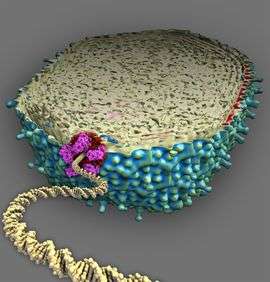
A team of physicists at the University of California, San Diego and biologists at Catholic University of America, Washington D.C. has shown that a tiny viral motor generates twice as much power, relative to its size, as an automobile engine. The finding explains why even very large viruses can self-assemble so rapidly.
In the study, published October 23 in the journal Proceedings of the National Academy of Sciences, the researchers used laser tweezers to measure the forces generated by a nanoscale motor that packs DNA into a virus during the assembly of an infectious virus particle. They discovered that the motor is considerably stronger than any known molecular motors, including those responsible for muscle contraction. The researchers say this power allows the virus to reel in its long genome with remarkable speed.
“The genome is about 1,000 times longer than the diameter of the virus,” explained Douglas Smith, an assistant professor of physics at UCSD and co-author of the study. “It is the equivalent of reeling in and packing 100 yards of fishing line into a coffee cup, but the virus is able to package its DNA in under five minutes.”
For the study, the researchers used bacteriophage T4—a tiny virus that infects E. Coli bacteria—because T4 is well characterized and amenable to the analysis of its functions in a test tube. They say that it should be feasible to extend their work to viruses that affect humans, such as adenoviruses, which cause colds, and herpes viruses, which cause chicken pox, shingles and cold sores.
“Historically, path-breaking work on bacteriophage assembly has led to breakthroughs in animal virus assembly,” said Venigalla Rao, a professor of biology at Catholic University of America and co-author on the paper. “Particularly since the assembly of herpes viruses very closely resembles that of bacteriophage T4, our work should provide important insights to set up herpes virus in vitro systems in the near future.”
The researchers say that their work could ultimately lead to better ways of designing antiviral medications. Drugs that target the DNA-packaging process could block the infection cycle by preventing viral assembly. Such drugs could also interfere with the ability of the virus to inject its DNA into the cells it infects because injection is facilitated by the high pressure at which the genetic material is packaged within the virus’ outer shell, or capsid.
To measure the forces produced by the molecular motor during packaging, the researchers attached a strand of viral DNA to one microscopic bead and attached another bead to an empty viral capsid that contained the nanomotor at its mouth. Using laser beams to hold onto each bead, they brought the DNA strand and capsid into proximity. They then measured the resistance produced by the motor as it grabbed the strand of DNA and pumped it into the viral capsid, as well as the speed at which the DNA was pumped.
Measurements of the dynamics of individual molecular motors provide information that cannot be obtained through traditional biochemical techniques.
“Laser tweezers are being used by several groups around the world to study molecular motors,” said Derek Fuller, a graduate student working with Smith, and the first author on the paper. “Since we measure single DNA molecules, it allows us to study dynamics on a much smaller scale than previous bulk studies where individual features are often averaged out.”
The T4 DNA-packaging motor was able to speed up and slow down as if it had gears. The researchers report that this is the first discovery of a molecular motor exhibiting widely variable speed, and they propose that the feature may have an important biological function. It may permit DNA repair, transcription or recombination—the swapping of bits of DNA to enhance genetic diversity—to take place before the genetic material is packaged within the viral capsid.
“The dynamic variability of packaging rate makes sense because, in the infected cell, the DNA is not fed to the motor as a free molecule,” explained Rao. “It is very likely a complex and highly metabolically active structure. Thus the motor needs to adjust the packaging rate to accommodate other processes.”
“Just as it is good for a car to have brakes and gears, rather than only being able to go 60 miles per hour, the DNA-packaging motor may need to slow down, or stop and wait if it encounters an obstruction,” added Smith.
Other contributors to the study were Dorian Raymer at UCSD and Vishal Kottadiel at Catholic University of America.
Source: University of California, San Diego


