400 Year Old Clam Found -- Oldest Animal Ever
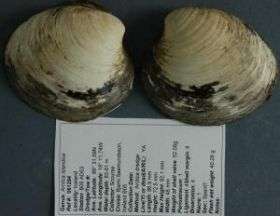
A clam dredged from Icelandic waters had lived for 400 years - is this the longest-lived animal known to science?
Can you imagine living for four centuries? A team of scientists from Bangor University's School of Ocean Sciences believe they have found an animal which did just that, a quahog clam, Arctica islandica, which was living and growing on the seabed in the cold waters off the north coast of Iceland for around 400 years.
When this animal was a juvenile, King James I replaced Queen Elizabeth I as English monarch, Shakespeare was writing his greatest plays Hamlet, Othello, King Lear and Macbeth and Giordano Bruno was burnt at the stake for espousing the view that the Sun rather than the Earth was the centre of the universe.
According to the Guinness Book of Records, the existing record for the longest-lived animal belongs to a 220 year old Arctica clam collected in 1982 from American waters. Unofficially, the record belongs to a 374 year old Icelandic clam which was found in a museum. Both these records appear to have been eclipsed by the latest specimen, whose age, between 405 and 410 years, has been assessed by counting the annual growth lines in the shell.
The Bangor scientists are sclerochronologists who study the growth and age of clams using annual growth lines in the shell in much the same way as dendrochronologists study the growth of trees using tree-rings. Clam shell growth is related to environmental conditions such as seawater temperature, salinity and food availability. The team analyse the shell growth histories with a view to understanding changes in the ocean linked to climate change.
The clam was dredged up by Team members Paul Butler and James Scourse during a data collection cruise in Icelandic coastal waters in 2006 which formed part of the EU MILLENNIUM project investigating climate changes over the last 1000 years. The exciting discovery was made by postdoctoral scientist Al Wanamaker, the newest member of the ‘Arctica’ team. “Al and Paul rushed up to my office to announce that they had found a record-breaker,” said team member Chris Richardson. A detailed assessment later confirmed that, at 400 years, the clam had beaten the previous record by a massive 30 years!!
It is very likely that longer lived individuals of the species remain to be found. Although Icelandic waters seem to provide the ideal conditions for extreme longevity, clams with lifetimes well in excess of 200 years have been found both in the Irish Sea and the North Sea.
So why do these clams live so long? The Bangor scientists are intrigued to find out and believe that the clams may have evolved exceptionally effective defences which hold back the destructive ageing processes that normally occur. "If, in Arctica islandica, evolution has created a model of successful resistance to the damage of ageing, it is possible that an investigation of the tissues of these real life Methuselahs might help us to understand the processes of ageing," explains Chris.
Source: Bangor University


