Bioengineers create stable networks of blood vessels
Feb 28, 2006
Bioengineers create stable networks of blood vessels
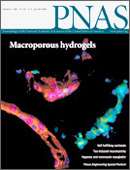
PNAS Cover, February 2006

Yale biomedical engineers have created an implantable system that can form and stabilize a functional network of fine blood vessels critical for supporting tissues in the body, according to a report in the Proceedings of the National Academy of Sciences.

For body tissue to survive it must receive oxygen delivered through the finest of blood vessels. Led by Erin Lavik, assistant professor of Biomedical Engineering, this study shows that the fine network of blood vessels can be formed. Further, detailed microscopic studies showed that the vascular networks were stable as implants for up to six weeks and were able to connect with larger blood vessel structures.

"This expands our understanding of the neuro-vascular niche and opens up ways to address repair of severed nerves," said Joseph Madri professor of pathology at Yale School of Medicine and a co-author. "We can now study what affects the attraction and repulsion of nerve growth and drug delivery in a model system that can be used in vitro and in vivo."

The researchers used two important engineering enhancements to develop stable functional microcirculation. First, they created a "micro-scaffold" of a macroporous hydrogel polymer. The hydrogel is a three-dimensional, sponge-like material -- highly water-saturable, with a structure of connected pores for cells to grow on and through.

Second, they seeded the hydrogel scaffolds with endothelial cells that make up blood vessel structure along with nerve progenitor cells from the brain. Because there is often an association of nerve connections with vascular networks, they tested to see if a combination of the blood vessel-forming and nerve-forming cells would enhance development of the vascular networks.

"By their nature, hydrogels are well suited for the transport of soluble factors, nutrients or drugs, and waste," said Lavik. "The hydrogel scaffold materials are generally highly biocompatible and safe to implant due to the presence of large volumes of water."

Source: Yale University

Explore further: Weekends are the best time to buy airline tickets, researchers find

add to favorites email to friend print save as pdf

Related Stories

How nanotechnology could keep your heart healthy

May 17, 2013

Since the heart is such a delicate and critical organ, clinicians usually opt not to intervene with the dead cells that remain after a heart attack or cardiac disease. "But we think that all heart attacks deserve some kind ...

Biomaterial shows promise for Type 1 diabetes treatment

May 09, 2013

(Phys.org) —Researchers have made a significant first step with newly engineered biomaterials for cell transplantation that could help lead to a possible cure for Type 1 diabetes, which affects about 3 ...

Nanoengineers can print 3D microstructures in mere seconds

Sep 13, 2012

(Phys.org)—Nanoengineers at the University of California, San Diego have developed a novel technology that can fabricate, in mere seconds, microscale three dimensional (3D) structures out of soft, biocompatible ...

Nanoparticles harvest invisible cancer biomarkers

Nov 22, 2011

(PhysOrg.com) -- Cancer biologists have long presumed that tumor cells shed telltale markers into the blood and that finding these blood-borne biomarkers could provide an early indicator that cancer is developing somewhere ...

Recommended for you

The ascent of man: Why our early ancestors took to two feet

May 24, 2013

A new study by archaeologists at the University of York challenges evolutionary theories behind the development of our earliest ancestors from tree dwelling quadrupeds to upright bipeds capable of walking and scrambling.

Challenging the public's view of gender and science

May 24, 2013

According to She Figures 2012, which analyses gender equality in research, in 2010 women accounted for only 10 % of university rectors in Europe and 15.5 % were heads of institutions of the higher education ...

User comments : 0

More news stories

Submerged structure stumps Israeli archaeologists

The massive circular structure appears to be an archaeologists dream: a recently discovered antiquity that could reveal secrets of ancient life in the Middle East and is just waiting to be excavated.

Mais non! French universities may teach in English

In France, there's a brewing debate over whether to speak anglais in universite. The National Assembly on Wednesday was taking up an education reform bill that would allow public universities to hold some courses—like science ...

Galaxies fed by funnels of fuel

(Phys.org) —Computer simulations of galaxies growing over billions of years have revealed a likely scenario for how they feed: a cosmic version of swirly straws.