Explaining Nanotech
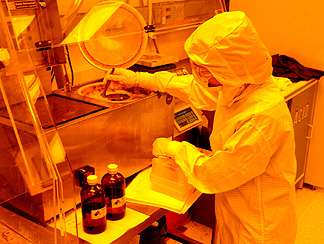
Who will operate the nanotechnology factories of the future? Will the public be able to make informed decisions about new nanometer-scale products and services? Will tomorrow’s nanotechnology industry face the same kind of backlash as today’s genetically-modified food industry?
These are some of the questions that concern Nancy Healy. As education coordinator for the National Nanotechnology Infrastructure Network (NNIN), she’s helping develop educational outreach programs designed to ensure that tomorrow’s workers have the right skills for nanotechnology industries – and that the public will be able to separate nanotechnology fact from fiction.
Her biggest challenge: helping people relate to structures whose size is measured in billionths of meters. And that’s without explaining the quantum mechanical effects that make ordinary processes such as friction dramatically different at the nanoscale.
“There’s a misperception that nanotechnology is really still science fiction,” said Healy, who described NNIN education efforts February 18th at the annual meeting of the American Association for the Advancement of Science (AAAS). “People generally don’t know what nanotechnology really is. There’s a risk that their perceptions will be based on popular culture portrayals of it rather than fact.”
The U.S. government is investing a billion dollars a year in the technology of the very small. The National Science Foundation (NSF) estimates that by the year 2015, nanotechnology will directly employ more than two million workers worldwide. Yet 80 percent of the people recently surveyed by the Project on Emerging Nanotechnologies admitted to knowing little or nothing about it.
“We still have a long road ahead in educating people,” said Healy, whose efforts are headquartered at the Georgia Institute of Technology. “But we don’t have much time because the technology is moving forward quickly. Nanotechnology is already here, though some of the most important aspects of it are still 10 or 15 years away.”
Today, nanotechnology is mostly seen as the province of Ph.D. scientists and engineers. But as the industry grows, it will need people at all education and skill levels to meet needs that range from cutting-edge research to maintenance of manufacturing equipment.
“The field is wide open,” Healy added. “There are many opportunities, not just for technical people, but also for specialists such as patent attorneys, pharmacists, entrepreneurs and marketers. The most important skill will be the ability to work with people in other disciplines – to be an interdisciplinary person.”
A consortium of 13 U.S. universities supported by the NSF, the NNIN supports a broad base of educational programs focused on K-12 students, teachers, undergraduate students – and the general public.
Goals of the effort include:
-- Exposing young people to nanotechnology research to help encourage them toward careers in science and engineering;
-- Training teachers and guidance counselors about experimental sciences, providing teaching tools and enhancing their enthusiasm for helping students pursue science and engineering careers;
-- Creating and distributing educational materials for children, college students, technical professionals, teachers and the general public, and
-- Focusing efforts on populations having disproportionately low employment and education in the sciences.
In pursuit of those goals, NNIN institutions are pursing a broad outreach effort that involves dozens of different projects. Typical activities include:
-- Summer “Nanotechnology Camps” designed to engage high-school students;
-- “Chip Camps” that teach students key nanotechnology processes hands-on;
-- Research Experience for Undergraduates (REU), a program that encourages college students to remain in science and engineering fields;
-- Development of an “Open Textbook” on nanotechnology;
-- Hands-on activities to help teachers understand nanotechnology and development of materials to help them teach the topic, and
-- Outreach activities such as Web sites, newsletters and presentations at national scientific meetings.
Though it’s too early to judge success, Healy says students participating in the NNIN REU program tend to stay in science and technology fields. The NNIN REU program is also growing, with 500 applicants in 2005.
Beyond developing a nanotechnology workforce, the NNIN education initiative is also working to help the general public understand the new industry.
“We want to avoid the problems that have come with genetically-modified organisms,” said Healy. “We want to make sure that the public understands the benefits, as well as the social and ethical issues. We have to be sure that the public is comfortable with this, and that if there are questions, that the scientists and engineers answer them.”
The National Nanotechnology Infrastructure Network (NNIN) is an integrated networking partnership of 13 universities that provide user facilities serving the resource needs of nanoscale science, engineering and technology. Further information on the Network can be found at www.nnin.org.
Source: Georgia Institute of Technology


