NASA Ships External Fuel Tank for Next Space Shuttle Mission
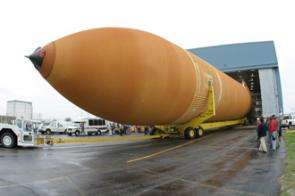
Space shuttle external tank ET-119 rolls out at NASA's Michoud Assembly Facility near New Orleans to begin its four-to-five-day sea journey to NASA's Kennedy Space Center, Fla. ET-119 will help launch Space Shuttle Discovery on its next mission, STS-121. NASA managers are targeting a May launch window. (Lockheed Martin)
In the aftermath of Hurricane Katrina, which devastated New Orleans, workers at the nearby NASA Michoud Assembly Facility persevered through their own personal hardships to deliver a newly designed external fuel tank for the space shuttle.
As a result, the tank that will help launch Space Shuttle Discovery on its next mission will head to NASA’s Kennedy Space Center, Fla., this weekend. The exact time of departure will be determined by real-time operational conditions.
The huge orange tank designated ET-119, will be loaded on a covered barge today at Michoud for shipment Saturday. The barge is expected to take five to six days to travel from the Mississippi River-Gulf of Mexico Outlet to Florida's Banana River, which flows into the Atlantic Ocean.
At Kennedy, the tank will be delivered to the Vehicle Assembly Building for final checkout and eventually attached to the twin solid rocket boosters and Discovery for its mission (STS-121) to the International Space Station. NASA managers are targeting a launch window for Discovery in May.
The tank feeds 535,000 gallons of liquid propellants – hydrogen and oxygen – to the shuttle's three main engines, which power it to orbit. For the first time, the tank will fly without Protuberance Air Load (PAL) ramps. The ramps were on the tank to protect a cable tray and two pressurization oxygen and hydrogen lines during the dynamic portion of launch, which includes liftoff through about the first three minutes of the climb to orbit. There are two PAL ramps on the external tank, one at the top of the liquid oxygen portion of the tank, which is 14 feet long and consists of 14 pounds of foam. The other is a liquid hydrogen PAL ramp, which is 38 feet long and contains 21 pounds of foam.
Following last summer’s shuttle mission, STS-114, detailed inspections, engineering analysis and testing were performed on external tanks at Michoud. As a result, the Space Shuttle Program determined the PAL ramps were not necessary and it would be a safety improvement to fly the remaining shuttle missions without the ramps on the tank.
Wind tunnel testing using the data is scheduled to begin in mid-March and continue through April to corroborate those conclusions. Additional work to the tank included minor redesign work on ice/frost ramps, the foam segments that cover support brackets at various locations along the pressurization lines. These ice/frost ramps were partially covered by the PAL ramps and were left exposed after the ramp was removed.
Work also was completed in the area of the tank's bipod fittings that connect the external tank to the orbiter through the shuttle's two forward attachment struts. The electrical harnesses that service the bipod heaters and temperature sensors were removed and replaced with improved versions designed to reduce the potential for nitrogen leakage from the intertank through the cables into the cryogenic region near the bipod fittings. To prevent nitrogen leakage underneath the cables, void spaces beneath the cables were eliminated by using an improved bonding procedure to ensure complete adhesive coverage.
STS-121’s seven astronauts will fly to the space station on the second mission in the Return to Flight sequence, which started with STS-114. Discovery’s crew will test new equipment and procedures designed to increase the safety of shuttles, deliver supplies and make repairs to the space station.
Source: NASA
-
From lemons to lemonade: Reaction uses carbon dioxide to make carbon-based semiconductor,
33 comments
-
Thioridazine kills cancer stem cells in human while avoiding toxic side-effects of conventional cancer treatments,
3 comments
-
SpaceX private rocket blasts off for space station (Update),
42 comments
-
Landmark calculation clears the way to answering how matter is formed,
55 comments
-
Research team claims to have found evidence Lake Cheko is impact crater for Tunguska Event,
18 comments
More news stories
Yale study concludes public apathy over climate change unrelated to science literacy
Are members of the public divided about climate change because they don't understand the science behind it? If Americans knew more basic science and were more proficient in technical reasoning, would public consensus match ...
12 hours ago |
4.8 / 5 (6) |
29
|
Land and sea species differ in climate change response: study
(Phys.org) -- Marine and terrestrial species will likely differ in their responses to climate warming, new research by Simon Fraser University and Australia’s University of Tasmania has found.
10 hours ago |
4 / 5 (5) |
6
|
10 million years needed to recover from mass extinction
It took some 10 million years for Earth to recover from the greatest mass extinction of all time, latest research has revealed.
Space & Earth / Earth Sciences
12 hours ago |
4.2 / 5 (5) |
3
|
Sophisticated simulations predict future warming
The chances of our planet being hit by a global warming of 3 degrees Celsius by 2050 is as likely as it being hit by an increase of 1.4 degrees, new research shows. Presented in the journal Nature Geoscience, the British study ...
Space & Earth / Earth Sciences
May 22, 2012 |
3.8 / 5 (11) |
51
Kyoto Protocol architect 'frustrated' by climate dialogue
UN climate talks are going nowhere, as politicians dither or bicker while the pace of warming dangerously speeds up, one of the architects of the Kyoto Protocol told AFP.
May 23, 2012 |
3.4 / 5 (8) |
43
Stunning image of smallest possible five-ringed structure
Scientists have created and imaged the smallest possible five-ringed structure about 100,000 times thinner than a human hair and you'll probably recognise its shape.
'Unzipped' carbon nanotubes could help energize fuel cells, batteries
Multi-walled carbon nanotubes riddled with defects and impurities on the outside could replace some of the expensive platinum catalysts used in fuel cells and metal-air batteries, according to scientists at ...
Change in developmental timing was crucial in the evolutionary shift from dinosaurs to birds: study
At first glance, it's hard to see how a common house sparrow and a Tyrannosaurus Rex might have anything in common. After all, one is a bird that weighs less than an ounce, and the other is a dinosaur that ...
Computer model used to pinpoint prime materials for efficient carbon capture
When power plants begin capturing their carbon emissions to reduce greenhouse gases and to most in the electric power industry, it's a question of when, not if it will be an expensive undertaking.
T cells 'hunt' parasites like animal predators seek prey, study shows
By pairing an intimate knowledge of immune-system function with a deep understanding of statistical physics, a cross-disciplinary team at the University of Pennsylvania has arrived at a surprising finding: T cells use a movement ...
Browser wars flare in mobile space
The browser wars are heating up again, but this time the fight is for dominance of the mobile Internet.