Spitzer Witnessed Galactic Collision
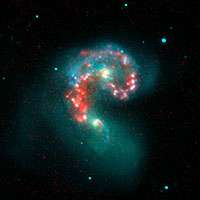
NASA's Spitzer Space Telescope has set its infrared sight on a major galactic collision and witnessed not death, but a teeming nest of life. The colliding galaxies, called the Antennae galaxies, are in the process of merging together. As they churn into each other, they throw off massive streamers of stars and dark clouds of dust. Spitzer's heat-seeking eyes peered through that dust and found a hidden population of newborn stars. The new Spitzer image is reported in one of 86 Spitzer papers published in the September issue of The Astrophysical Journal Supplement. This special all-Spitzer issue comes just after the one-year anniversary of the observatory's launch, and testifies to its tremendously successful first year in space.
"This abundance of Spitzer papers just one year after launch shows that the telescope is truly providing a new window on the universe," said Dr. Michael Werner, project scientist for Spitzer at NASA's Jet Propulsion Laboratory, Pasadena, Calif. "These papers report the earliest results, so the best is yet to come."
In the latest Antennae galaxies study, Spitzer uncovered a new generation of stars at the site where the two galaxies clash.
"We theorized that there were stars forming at that site, but we weren't sure to what degree," said Dr. Zhong Wang, lead author of the new paper and an astronomer at the Harvard-Smithsonian Center for Astrophysics, Cambridge, Mass. "Now we see that the majority of star-forming activity in both galaxies occurs in the overlap regions where the two meet."
The Antennae galaxies are a classic example of a galactic merger in action. These two spiral galaxies, located 68 million light-years away from Earth, began falling into each other around a common center of gravity about 800 million years ago. As they continue to crash together, clouds of gas are shocked and compressed in a process thought to trigger the birth of new stars. Astronomers believe that the two galaxies will ultimately merge into one spheroidal-shaped galaxy, leaving only hints of their varied pasts.
Galactic mergers are common throughout the universe and play a key role in determining how galaxies grow and evolve. Our own Milky Way galaxy, for example, will eventually collide with our closest neighbor, the Andromeda galaxy.
Previous images of the Antennae taken by visible-light telescopes show striking views of the swirling duo, with bright pockets of young stars dotting the spiral arms. At the center of the galaxies, however, where the two overlap, only a dark cloud of dust can be seen. In the new false-color Spitzer image, which has been combined with an image from a ground-based, visible-light telescope to highlight new features, this cloud of buried stars appears bright red. The visible-light information, on the other hand, is colored blue and indicates regions containing older stars. The nuclei, or centers, of the two galaxies are white.
"This more complete picture of star-formation in the Antennae will help us better understand the evolution of colliding galaxies, and the eventual fate of our own," said Dr. Giovanni Fazio, a co-author of the research and an astronomer at the Harvard-Smithsonian Center for Astrophysics." Fazio is principal investigator for the infrared array camera on Spitzer, which captured the new Antennae image.
JPL manages the Spitzer Space Telescope mission for NASA's Science Mission Directorate, Washington. Science operations are conducted at the Spitzer Science Center at the California Institute of Technology in Pasadena. JPL is a division of Caltech. Spitzer's infrared array camera was built by NASA Goddard Space Flight Center, Greenbelt, Md.
Information about Spitzer can be found at www.spitzer.caltech.edu .


