Dying star creates fantasy-like sculpture of gas and dust
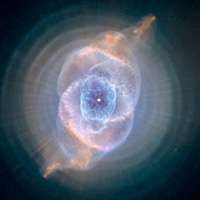
A new study of a large number of planetary nebulae has revealed that rings, such as those seen here around the Cat's Eye Nebula, are much more common that thought so far and have been found in at least one third of all planetary nebulae. Although the rings may be the key to explaining the final agonized 'gasp' of the dying central star, the mystery behind the Cat's Eye nebula's nested Russian doll structure remains largely unsolved.
In this detailed view from the NASA/ESA Hubble Space Telescope, the so-called Cat's Eye Nebula looks like the penetrating eye of the disembodied sorcerer Sauron from the film adaptation of "Lord of the Rings."
The nebula, formally catalogued NGC 6543, is every bit as inscrutable as the J.R.R. Tolkien phantom character. Although the Cat's Eye Nebula was the first planetary nebula ever to be discovered, it is one of the most complex planetary nebulae ever seen in space. A planetary nebula forms when Sun-like stars gently eject their outer gaseous layers to form bright nebulae with amazing twisted shapes.
Hubble first revealed NGC 6543's surprisingly intricate structures including concentric gas shells, jets of high-speed gas and unusual shock-induced knots of gas in 1994.
As if the Cat's Eye itself isn't spectacular enough, this new image, taken with Hubble's Advanced Camera for Surveys (ACS), reveals the full beauty of a bull's eye pattern of eleven or more concentric rings, or shells, around the Cat's Eye. Each 'ring' is actually the edge of a spherical bubble seen projected onto the sky - which is why it appears bright along its outer edge.
Observations suggest that the star ejected its mass in a series of pulses at 1500-year intervals. These convulsions created dust shells that each contains as much mass as all of the planets in our Solar System combined (but still only one-percent of the Sun's mass). These concentric shells make a layered onion-skin structure around the dying star. The view from Hubble is like seeing an onion cut in half, where each layer of skin is discernable.
Until recently, it was thought that shells around planetary nebulae were a rare phenomenon. However, Romano Corradi (Isaac Newton Group of Telescopes, Spain) and collaborators, in a paper published in the European journal Astronomy & Astrophysics in April 2004, have instead shown that the formation of these rings is likely to be the rule rather than the exception.
The bull's-eye patterns seen around planetary nebulae come as a surprise to astronomers because they had no expectation of episodes of mass loss at the end of stellar lives that repeat every 1,500 years or so. Several explanations have been proposed, including cycles of magnetic activity somewhat similar to our own Sun's sunspot cycle, the action of companion stars orbiting around the dying star, and stellar pulsations. Another school of thought is that the material is ejected smoothly from the star, and the rings are created later on due to formation of waves in the outflowing material. It will take further observations and more theoretical studies to decide between these and other possible explanations.
Approximately 1000 years ago the pattern of mass loss suddenly changed, and the Cat's Eye Nebula itself started forming inside the dusty shells. It has been expanding ever since, as can be seen by comparing Hubble images taken in 1994, 1997, 2000 and 2002. But what has caused this dramatic change? Many aspects of the process that leads a star to lose its gaseous envelope are poorly known, and the study of planetary nebulae is one of the few ways to recover information about the last few thousand years in the life of a Sun-like star.


