'Crowcam' spies on clever birds
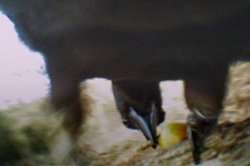
A new technique developed by Oxford University zoologists enables researchers to ‘hitch a ride’ with wild birds and witness their natural and undisturbed behaviour.
The scientists developed miniaturised video cameras with integrated radio-tags that can be carried by wild, free-flying birds. Using this new ‘video-tracking’ technology, they spied on the behaviour of New Caledonian crows, a species renowned for its sophisticated use of tools, recording behaviours never seen before.
Observing New Caledonian crows in the wild is extremely difficult because they are easily disturbed and live in densely forested, mountainous terrain. ‘Video-tracking’ enabled the Oxford scientists to obtain particularly intimate observations of crow behaviour.
‘Everyone thought that New Caledonian crows use tools mainly to probe into holes and cracks in rotting wood and tree crowns, but we now discovered that they use tools even on the ground,’ said Dr Christian Rutz, from the Behavioural Ecology Research Group at Oxford’s Department of Zoology. One crow was seen probing leaf litter with grass-like stems – a mode of tool use, and a tool material, that decades of observation with conventional techniques had missed. ‘This discovery highlights the power of our new video-tracking technology’ said Dr Rutz, who leads the group’s field research. ‘This is the first time that wild birds have been tracked in this way, and it has already changed our understanding of New Caledonian crow behaviour.’
For the study, 18 crows were fitted with ‘tailcams’ with each unit weighing about 14 grams – only slightly heavier than a conventional radio-tag. The units were attached to two tail feathers with strips of adhesive tape, and were designed so that they did not adversely affect the bird’s movements, and could be removed by the crows themselves or would detach after a few weeks with the birds’ natural moulting process.
‘Observing wild birds this closely in their natural habitat has been one of the final frontiers of ornithological field research,’ said Dr Rutz. ‘Whilst video footage has been taken before using tame, trained birds, it is only now that we have been able to design cameras that are small and light enough to travel with wild birds and let them behave naturally. Potentially, this new video technology could help us to answer some long-standing questions about the ecology and behaviour of many other bird species that are otherwise difficult to study.’
A report of the research, entitled ‘Video Cameras on Wild Birds’ was published in Science Express on Thursday 4 October 2007. The research was undertaken by Dr Christian Rutz, Lucas Bluff, Dr Alex Weir and Professor Alex Kacelnik from the Behavioural Ecology Research Group at the Department of Zoology and was funded by the Biotechnology and Biological Sciences Research Council (BBSRC).
Source: University of Oxford


