Pear-shaped particles probe big-bang mystery
A University of Sussex-led team of scientists is ahead in the race to solve one of the biggest mysteries of our physical world: why the Universe contains the matter that we're made of.
In a paper submitted to Physical Review Letters, the team has just announced the results of a ten-year project to make one of the most sensitive measurements ever of sub-atomic particles. Theories attempting to explain the creation of matter in the aftermath of the Big Bang now have to be tuned up - or thrown out.
Physicist Dr Philip Harris, the head of the Sussex group, says: "This represents a significant breakthrough, and a real success for UK particle physics. Although there are a couple of other teams in the world working in this same area, we're managing to stay ahead of them. It's been said in the past that this experiment has disproved more theories than any other in the history of physics - and now it's delivering the goods all over again."
The question that has vexed scientists and astronomers for years is why there is more matter in the Universe than anti-matter. Both were formed at the time of the Big Bang, about 13.7 billion years ago. For every particle formed, an anti-particle should also have been formed. Almost immediately, however, the equal numbers of particles and anti-particles would have annihilated each other, leaving nothing but light. But a tiny asymmetry in the laws of nature resulted in a little matter being left over, spread thinly within the empty space of the Universe. This became the stars and planets that we see around us today.
The only way scientists can verify their theories to explain this anomaly is to study the corresponding asymmetry in sub-atomic particles, by looking for slight "pear-shaped" distortions in their otherwise spherical forms. It has taken five decades of research to reach the stage where measurements of these particles, called neutrons, have become sensitive enough to test the very best candidate theories. Neutrons are electrically neutral, but they have positive and negative charges moving around inside them. If the centres of gravity of these charges aren't in the same place, it would result in one end of the neutron being slightly positive, and the other slightly negative. This is called an electric-dipole moment, and it is the phenomenon that physicists have been working to find for the past 50 years. Spinoffs from the original pioneering work in this area include atomic clocks and magnetic-resonance imaging.
The new result shows that the distortion in the subatomic particles is far smaller than most of the origin-of-matter theories had predicted - if the neutron were the size of the Earth, the distortion would still be less than the size of a bacterium. "This will really help to constrain theories that attempt to go beyond our current understanding of the fundamental laws of physics", says Dr Harris. "For some of them, it's back to the drawing board; but for the better ones, it will definitely show them the way forwards."
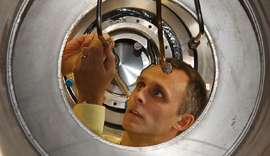
To carry out the research the Sussex group, together with scientists from the Rutherford Appleton Laboratory and the Institut Laue Langevin in Grenoble, built a special type of atomic clock that used spinning neutrons instead of atoms. It applied 120,000 volts to a quartz "bottle" that was filled regularly with neutrons captured from a reactor. The clock frequency was measured through nuclear magnetic resonance.
The team has now expanded to include Oxford University and the University of Kure in Japan. They are busy developing a new version of the experiment: By submerging their neutron-clock in a bath of liquid helium, half a degree above absolute zero, they will increase their sensitivity a hundredfold.
Source: University of Sussex


