Modeling Swarm Behavior
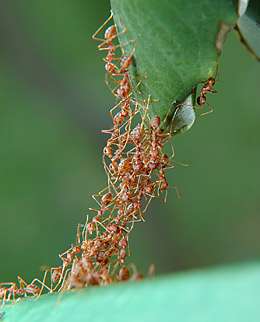
The swarming behavior of ants, bees, termites, and other social insects has implications far beyond the hive. Swarm intelligence — the collective behavior of independent agents, each responding to local stimuli without supervision — can be used to understand and model phenomena as diverse as blood clotting, highway traffic patterns, gene expression, and immune responses, to name just a few. Swarm technology is proving useful in a wide range of applications including robotics and nanotechnology, molecular biology and medicine, traffic and crowd control, military tactics, and even interactive art.
Students and faculty in the Evolutionary and Swarm Design (ESD) Research Group at the University of Calgary, Canada, use Mac computers and Mac OS X to model swarm behavior and to apply it to an ever-increasing number of real-world problems. Swarm modeling theories provide new conceptual frameworks for extending the field of artificial intelligence and suggest new possibilities for computer hardware and software design.
Christian Jacob has led the ESD Research Group since its inception. Like many swarm researchers, he believes that biologically-inspired computational tools like the ones being developed in the ESD Research Group will prove invaluable for developing many of the important technologies of the twenty-first century.
“What I find intriguing is the fact that very similar principles seem to apply to swarm-like systems regardless of scale,” Jacob says. “We can use the models that describe army ant raiding behavior to predict the behavior of automobile traffic or pedestrians on the road. The models that describe how birds and fish flock and school have practical applications in, for example, genetic algorithm test functions and the training of artificial neural network weights.”
A Mind of Its Own
In contrast to the top-down organization that characterizes many human endeavors, many social species achieve their communal goals using a purely bottom-up approach with no central command-and-control structure. A swarm of termites, for example, exhibits a collective intelligence that far exceeds the intelligence of any individual insect, which by itself has limited capabilities for processing and communicating information.
The collective intelligence of the swarm emerges in a decentralized way from the actions of individual insects responding to local stimuli from the environment and, most importantly, from other members of the swarm. There is no “boss” in charge. No individual insect grasps the big picture. Yet in the aggregate, the local actions of each insect based on the local stimuli available to it can accomplish a collective goal that serves the interests of the whole community.
“It turns out that what makes sense in the biological world often make sense in the computational world as well,” explains Jacob. “For some types of applications, a collection of small, simple agents with limited intelligence, local decision-making capability, and a communication path to nearby peers can outperform a large centralized processor. Moreover, a decentralized system has several important advantages over a centralized one, most notably robustness and flexibility.”
Source: University of Calgary (By Frank Lacombe)


