Bacterium found to have strange magnetic personality
Feb 17, 2006
Bacterium found to have strange magnetic personality
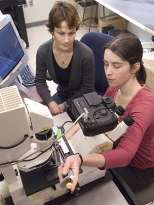
Sheri Simmons uses a pipette to place water samples onto a microscope slide to look at the swimming behavior of magnetotactic bacteria. Her advisor and co-author, Katrina Edwards, is at left. Photo / Tom Kleindinst, Woods Hole Oceanographic Institution

Researchers led by an MIT graduate student have discovered a bacterium that is a magnetic misfit of sorts. Magnetotactic bacteria contain chains of magnetic iron minerals that allow them to orient in the Earth's magnetic field, like living compass needles. These bacteria have long been observed to respond to high oxygen levels in the lab by swimming toward geomagnetic north in the Northern Hemisphere and geomagnetic south in the Southern Hemisphere.

But now researchers from MIT, the Woods Hole Oceanographic Institution (WHOI) and Iowa State University have found a bacterium in New England that does just the opposite: a Northern Hemisphere creature that swims south.

Because this behavior doesn't make sense in the natural environment of the bacteria, where swimming south would take them away from areas with their preferred oxygen level, the researchers believe there must be other explanations for why some magnetotactic bacteria swim in particular directions.

The team dubbed the bacterium the barbell for its appearance. In a study reported in the Jan. 20 issue of Science, they describe how they used genetic sequencing and other laboratory techniques to identify the barbell, which was found coexisting with other previously described magnetotactic bacteria in Salt Pond on Cape Cod.

Magnetotactic bacteria are found throughout the world in chemically stratified marine and freshwater environments, said lead author Sheri Simmons, a graduate student in the MIT Department of Biology and the MIT/WHOI Joint Program in Oceanography and Applied Ocean Science and Engineering.

The coexistence of magnetotactic bacteria with north and south polarity in the same environment contradicts the currently accepted model of magnetotaxis, which says that all magnetotactic bacteria in the Northern Hemisphere swim north and downward to reach their desired habitat when exposed to high-oxygen conditions.

Simmons and colleagues studied the bacteria under laboratory conditions and say the behavior of the bacteria in situ could be different from laboratory behavior. Their results, however, suggest new models are needed to explain how these magnetotactic bacteria behave in the environment.

Source: MIT

Explore further: New study offers insight into how to best manage workaholics

add to favorites email to friend print save as pdf

Related Stories

Recommended for you

New study offers insight into how to best manage workaholics

6 minutes ago

(Phys.org) —Workaholics tend to live in extremes, with great job satisfaction and creativity on the one hand and high levels of frustration and exhaustion on the other hand. Now, a new Florida State University study offers ...

The tea party and the politics of paranoia

46 minutes ago

Members of tea party claim the movement springs from and promotes basic American conservative principles such as limited government and fiscal responsibility.

The new retirement: No retirement?

1 hour ago

For growing numbers of Americans, the new retirement may really mean no retirement. That's the conclusion of an article in the current issue of the ISR Sampler, the annual magazine of the University of Michigan Institute ...

Striking a balance on taxes

1 hour ago

Now that April 15 has come and gone, most Americans have turned their attention away from taxes. But MIT student Stefanie Stantcheva continues to ponder the trade-offs associated with taxation.

User comments : 0

More news stories

The new retirement: No retirement?

For growing numbers of Americans, the new retirement may really mean no retirement. That's the conclusion of an article in the current issue of the ISR Sampler, the annual magazine of the University of Michigan Institute ...

Striking a balance on taxes

Now that April 15 has come and gone, most Americans have turned their attention away from taxes. But MIT student Stefanie Stantcheva continues to ponder the trade-offs associated with taxation.

Social media puts HR ethics under the spotlight

Social media has definitely changed the game for job-seekers and recruiters. Traditionally, HR recruiters placed an advertisement, sifted through the responses, and interviewed the shortlisted candidates ...

Theorists weigh in on where to hunt dark matter

(Phys.org) —Now that it looks like the hunt for the Higgs boson is over, particles of dark matter are at the top of the physics "Most Wanted" list. Dozens of experiments have been searching for them, but ...

DNA damage: The dark side of respiration

(Phys.org) —Adventitious changes in cellular DNA can endanger the whole organism, as they may lead to life-threatening illnesses like cancer. Researchers at LMU now report how byproducts of respiration cause mispairing ...