To maximize biofuel potential, researchers look for sorghum's 'sweet spot'
Sep 12, 2007
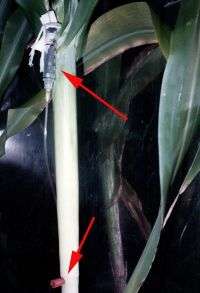
Sorghum IV Arrows
Researchers insert an IV into the sorghum plant as a means of infusing the tracer sucrose, so that they can track the movement and distribution of sugar within the growing plant. Credit: Jay Cockrell, TAES

Picture this - IV (intravenous) lines in a sorghum field. It's not as far-fetched as it sounds. It's one way that scientists at the Texas Agricultural Experiment Station are researching crops that may contribute to the biofuel revolution.

In Beaumont, Dr. Lee Tarpley, plant physiologist, and College Station colleague, Dr. Don Vietor, professor of crop physiology, have focused their research on sweet sorghum.

While sweet sorghum and sugarcane are close relatives, the researchers have shown that the two species have different ways of moving and storing sugar. Tracer sucrose is inserted into growing plants, using a system similar to an IV. Once the sucrose is inside the plants, the researchers can track the movement and distribution.

They found that, due to the plant's physiology, sweet sorghum appears to be more efficient in reusing the stored sugar to support growth of other parts of the plant. The mechanisms in sugarcane, however, allow it to accumulate very high levels of sucrose.

"The differences are critical, and need to be understood for breeders to develop new varieties specifically for the biofuel industry," Tarpley said. Sweet sorghum and sugarcane are both well suited for this purpose.

"While sorghum is an annual and can fit well into a crop rotation, sugarcane is a suitable perennial for many areas," Tarpley said. But to maximize the potential of sweet sorghum as a biofuel crop, breeders need to understand the physiology of the plant and not use sugarcane as a model.

"There is a large body of research on sugarcane that was previously thought to apply equally well to sorghum. Instead, we need to fully understand how sorghum moves and stores sugar in order to elevate to the next level in our breeding efforts," Tarpley said.

The study results were published in the June 2007 issue of BMC Plant Biology (www.biomedcentral.com/1471-2229/7/33).

Source: Texas A&M University

Explore further: Front-row seats to climate change

add to favorites email to friend print save as pdf

Related Stories

Sorghum a sweet treat for zoo animals

Dec 20, 2011

(PhysOrg.com) -- Scraps from sweet sorghum harvested for biofuel production enrich the diets of elephants, monkeys, parrots and other animals in Tucson' Reid Park Zoo.

Sorghum eyed as a southern bioenergy crop

Sep 17, 2012

Sweet sorghum is primarily grown in the United States as a source of sugar for syrup and molasses. But the sturdy grass has other attributes that could make it uniquely suited to production as a bioenergy ...

Recommended for you

Honeybees trained in Croatia to find land mines

6 hours ago

(AP)—Mirjana Filipovic is still haunted by the land mine blast that killed her boyfriend and blew off her left leg while on a fishing trip nearly a decade ago. It happened in a field that was supposedly ...

Front-row seats to climate change

May 17, 2013

By day, insects provide the white noise of the South, but the night belongs to the amphibians. In a typical year, the Southern air hangs heavy from the humidity and the sounds of wildlife.

Climate change may have little impact on tropical lizards

May 17, 2013

A new Dartmouth College study finds human-caused climate change may have little impact on many species of tropical lizards, contradicting a host of recent studies that predict their widespread extinction in a rapidly warming ...

Wetlands: value to locals matters most

May 17, 2013

A new way of valuing ecosystem services, incorporating the local perspective, is the driving force behind a project assessing aquatic ecosystems in highland areas of Asia

User comments : 0

More news stories

Honeybees trained in Croatia to find land mines

(AP)—Mirjana Filipovic is still haunted by the land mine blast that killed her boyfriend and blew off her left leg while on a fishing trip nearly a decade ago. It happened in a field that was supposedly ...

Bold action, big money needed to curb Asia floods

Asia's flood-prone megacities should fund major drainage, water recycling and waste reduction projects to stem deluges and secure clean supply for their booming populations, experts said Sunday.