Tabletop nuclear fusion device developed
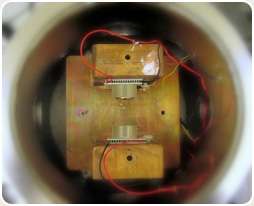
Researchers at Rensselaer Polytechnic Institute have developed a tabletop accelerator that produces nuclear fusion at room temperature, providing confirmation of an earlier experiment conducted at the University of California, Los Angeles (UCLA), while offering substantial improvements over the original design.
The device, which uses two opposing crystals to generate a powerful electric field, could potentially lead to a portable, battery-operated neutron generator for a variety of applications, from non-destructive testing to detecting explosives and scanning luggage at airports. The new results are described in the Feb. 10 issue of Physical Review Letters.
“Our study shows that ‘crystal fusion’ is a mature technology with considerable commercial potential,” says Yaron Danon, associate professor of mechanical, aerospace, and nuclear engineering at Rensselaer. “This new device is simpler and less expensive than the previous version, and it has the potential to produce even more neutrons.”
The device is essentially a tabletop particle accelerator. At its heart are two opposing “pyroelectric” crystals that create a strong electric field when heated or cooled. The device is filled with deuterium gas — a more massive cousin of hydrogen with an extra neutron in its nucleus. The electric field rips electrons from the gas, creating deuterium ions and accelerating them into a deuterium target on one of the crystals. When the particles smash into the target, neutrons are emitted, which is the telltale sign that nuclear fusion has occurred, according to Danon.
A research team led by Seth Putterman, professor of physics at UCLA, reported on a similar apparatus in 2005, but two important features distinguish the new device: “Our device uses two crystals instead of one, which doubles the acceleration potential,” says Jeffrey Geuther, a graduate student in nuclear engineering at Rensselaer and lead author of the paper. “And our setup does not require cooling the crystals to cryogenic temperatures — an important step that reduces both the complexity and the cost of the equipment.”
The new study also verified the fundamental physics behind the original experiment. This suggests that pyroelectric crystals are in fact a viable means of producing nuclear fusion, and that commercial applications may be closer than originally thought, according to Danon.
“Nuclear fusion has been explored as a potential source of power, but we are not looking at this as an energy source right now,” Danon says. Rather, the most immediate application may come in the form of a battery-operated, portable neutron generator. Such a device could be used to detect explosives or to scan luggage at airports, and it could also be an important tool for a wide range of laboratory experiments.
The concept could also lead to a portable x-ray generator, according to Danon. “There is already a commercial portable pyroelectric x-ray product available, but it does not produce enough energy to provide the 50,000 electron volts needed for medical imaging,” he says. “Our device is capable of producing about 200,000 electron volts, which could meet these requirements and could also be enough to penetrate several millimeters of steel.”
In the more distant future, Danon envisions a number of other medical applications of pyroelectric crystals, including a wearable device that could provide safe, continuous cancer treatment.
Frank Saglime, a graduate student in nuclear engineering at Rensselaer, also contributed to the research.
Source: Rensselaer Polytechnic Institute


