Male deer are born to live fast, die young
Aug 31, 2007
Iberian Red Deer
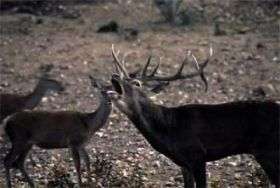
Roaring male Iberian red deer with females (photograph by Juan Carranza).

In the September issue of The American Naturalist, Juan Carranza (Biology and Ethology Unit, University of Extremadura, Spain) and Javier Pérez-Barbería (Macaulay Institute, United Kingdom) offer a new explanation for why males of ungulate species subjected to intense competition are born with lower survival expectancies than females.

The research reveals that male ungulates have smaller molars relative to their body size – and hence less durable teeth that will wear out sooner, which might contribute to their shorter lives compared with females.

Natural selection favors reproduction rather than survival; the cost of reproduction compromises survival. Males of species subjected to intense male-male competition for access to females are known to have shorter life expectancies than females. Earlier aging in males might be related to higher reproductive costs, especially when lifetime reproductive success in males takes place within the few years when they can win contests and maintain their dominance.

By comparing body and dental size of males and females of 123 species of ungulates, the authors offer another compelling explanation for why male ungulates lead shorter lives. They estimated the pattern of change of these traits along the evolutionary development of the group and found that for species where a single male has many females and where the males and females are different sizes, the rate of increase of dental size was lower than that of body size.
As a result, smaller teeth (in comparison to body size) are produced in males. It is possible that natural selection did not produce larger, more durable teeth because there was no reproductive return from it, since males in these species do not generally increase their success by living longer after prime age.

“These findings,” the authors state, “provide us with interesting insights into how natural and sexual selection design our bodies and their longevity.”

Citation: Juan Carranza and F. Javier Pérez-Barbería, "Sexual selection and senescence: male size-dimorphic ungulates evolved relatively smaller molars than females", The American Naturalist (2007) volume 170:370–380. DOI: 10.1086/519852

Source: University of Chicago Press Journals

Explore further: Reports from the Central African Republic indicate security has returned to Dzanga-Sangha National Park

add to favorites email to friend print save as pdf

Related Stories

Lovelorn frogs bag closest crooner

May 20, 2013

What lures a lady frog to her lover? Good looks, the sound of his voice, the size of his pad or none of the above? After weighing up their options, female strawberry poison frogs (Oophaga pumilio) bag th ...

Gender-bending fish share their secrets

May 16, 2013

When David Booth spotted his first seadragon he thought the colourful 40 centimetre-long fish looked like an intergalactic hybrid: half alien, half animated seaweed. "They are amazing things," the marine ...

The cicadas are rising: US invasion in 5, 4, 3...

May 14, 2013

The hordes are rising. A cicada invasion is imminent in the US, with millions of the large cricket-like insects poised to emerge from the earth after 17 years lying in wait. The first of the bugs that are ...

Recommended for you

New method for assessing future tree and plant disease risks

2 hours ago

A new method for assessing the impacts and risks of potential future tree and plant pest and disease outbreaks has been developed by the University's Professor Robert Fraser as one of the key recommendations of the government ...

Slow pokes: Acupuncture helps hypothermic turtles

3 hours ago

Two endangered sea turtles that are shells of their former selves after getting stranded on Cape Cod during a cold spell are getting some help easing back into the wild—from an acupuncturist.

'Whodunnit' of Irish potato famine solved

8 hours ago

An international team of scientists reveals that a unique strain of potato blight they call HERB-1 triggered the Irish potato famine of the mid-19th century.

User comments : 0

More news stories

Slow pokes: Acupuncture helps hypothermic turtles

Two endangered sea turtles that are shells of their former selves after getting stranded on Cape Cod during a cold spell are getting some help easing back into the wild—from an acupuncturist.

Space drives e-mobility

An ESA business incubation start-up company is helping major car manufacturers to develop electric vehicle concepts and improve safety systems by turning ideas quickly into virtual prototypes.

New factor to control oncogene-induced senescence

An article published on the journal Nature describes the major role that Pyruvate dehydrogenase (PDH) —an enzyme of cellular energy metabolism— plays in the regulation of the cellular senescence induce ...