Folate mystery finally solved
Aug 22, 2007
Folate Biosynthesis
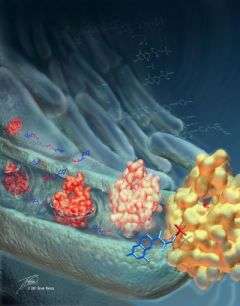
The accompanying image illustrates the stages of enzyme activity of the first step of folate biosynthesis: free enzyme (orange), enzyme with substrate bound (salmon), and enzyme with pyrophosphate bound (gold), superimposed on a drawing of E. coli and the folate biosynthetic pathway. The free floating substrate is shown in blue, with the phosphates in red. Credit: The rendition was contributed by Devon Nikasa an alumna of the Art as Applied to Medicine Program at Hopkins.

Some biochemical processes, especially those in bacteria, have been so well studied it’s assumed that no discoveries are left to be made. Not so, it turns out, for Johns Hopkins researchers who have stumbled on the identity of an enzyme that had been a mystery for more than 30 years. The report appears in the May 15 issue of Structure.

“It was really quite a surprise when we realized we had discovered the unknown player in how bacteria make the B vitamin folate, a player that we’ve known of since 1974,” says study author L. Mario Amzel, Ph.D., professor and director of biophysics and biophysical chemistry at Hopkins. “Basic research can be so serendipitous at times.”

Amzel and colleague Maurice Bessman and their labs were in the middle of systematically characterizing how members of a family of related enzymes in bacteria can recognize specific molecules. With each family member, they isolated purified enzyme, grew crystals of pure enzyme, and figured out the enzyme’s 3-D structure by using techniques that use X-rays.

Armed with the 3-D structure, they then used computer modeling to analyze how the enzyme binds to and acts on another molecule, its substrate.

“We still didn’t know that it was anything special until Maurice started searching old publications,” says study author Sandra Gabelli, Ph.D. “As it turns out, Suzuki and coworkers in 1974 had published evidence of an enzyme in the bacteria E. coli with similar characteristics to ours that could initiate folate biosynthesis.”

“So we had to ask, Can the bacteria make folate if we remove the orf17 gene"” says Amzel. Bessman and colleagues then “knocked-out” the gene and, predictably, the bacteria made 10 times less folate than usual.

“It was such a sweet discovery,” says Gabelli. “It’s scientific discovery the old-fashioned way, finding something we weren’t looking for.”

The mechanics behind how bacteria make folate are of particular interest to scientists who want to design more powerful antibacterial drugs. Humans cannot make folate because they do not have any of the same molecular machinery. Therefore, it’s possible to design drugs that target the bacterial folate machinery that would not lead to side effects in humans.

Their discovery, says Amzel, identifies yet another potential antibacterial target. “We are not in that business of drug design—we’re focused on the basics, figuring out how things work,” he says. “We do hope that others can use what we find to make new drugs.”

Source: Johns Hopkins Medical Institutions

Explore further: RNA capable of catalyzing electron transfer on early earth with iron's help, study says

add to favorites email to friend print save as pdf

Related Stories

Researchers find new chink in a 'superbug's' armor

Dec 08, 2006

Infections from drug-resistant forms of Staphylococcus bacteria are skyrocketing and have even recently made headlines by debilitating some of the NFL’s toughest players. Tools to fight these bugs are few, but now University ...

Recommended for you

Attacking MRSA with metals from antibacterial clays

May 17, 2013

In the race to protect society from infectious microbes, the bugs are outrunning us. The need for new therapeutic agents is acute, given the emergence of novel pathogens as well as old foes bearing heightened antibiotic resistance.

Beautiful 'flowers' self-assemble in a beaker

May 16, 2013

By simply manipulating chemical gradients in a beaker of fluid, materials scientists at Harvard have found that they can control the growth behavior of crystals to create precisely tailored structures—such ...

Reading the unreadable

May 16, 2013

Pioneering X-ray technology is making it possible to read fragile rolled-up historical documents for the first time in centuries.

User comments : 0

More news stories

Attacking MRSA with metals from antibacterial clays

In the race to protect society from infectious microbes, the bugs are outrunning us. The need for new therapeutic agents is acute, given the emergence of novel pathogens as well as old foes bearing heightened antibiotic resistance.

Beautiful 'flowers' self-assemble in a beaker

By simply manipulating chemical gradients in a beaker of fluid, materials scientists at Harvard have found that they can control the growth behavior of crystals to create precisely tailored structures—such ...

Honeybees trained in Croatia to find land mines

(AP)—Mirjana Filipovic is still haunted by the land mine blast that killed her boyfriend and blew off her left leg while on a fishing trip nearly a decade ago. It happened in a field that was supposedly ...

Mice, gerbils perish in Russia space flight

A number of mice and eight gerbils sent into space in a Russian capsule destined to find out how well organisms can withstand extended flights perished during their journey, scientists said Sunday as the ...

Bold action, big money needed to curb Asia floods

Asia's flood-prone megacities should fund major drainage, water recycling and waste reduction projects to stem deluges and secure clean supply for their booming populations, experts said Sunday.